

Have you ever felt like your discrete trials have become a “trial” (see what I did there?)? Let’s face it, when you are doing something that are sometimes called drills they can get downright boring. And trust me, if I’m bored, the learner is bored. And boredom leads to poor engagement which leads to delayed learning. So, I wanted to share how to make discrete trials a little more interesting, fun, and engaging for you and the student.
In the series, I have covered giving the instruction to the student, presenting the materials and providing a prompt if it is needed. So, the next component is the student’s response. This is where we can start to really have some fun, because it turns out there are many ways that the student can respond beyond the boring, “point to,” “give me,” and “touch.” Clearly we can have correct and incorrect responses and we can independent and prompted responses. However, as long as we get the response, the way we get it is not that important. What is always the most important is keeping the student engaged in learning.
So, to help me figure out many different ways I asked some of my bloggy friends from #WeTeachSped to share some ideas as well. I have some quotes down below but I worked some of their answers into the list and credited them where it was appropriate.
How many times have you said, “Touch ___” or “Give me ___.”? I talked early in this series about the fact that it’s the ____ that we are concerned about. Yes, the student needs to learn many different ways of giving an answer, but that doesn’t mean we are limited to giving, touching and show me.
Some of these will depend on the type of response you are looking for. Click on the person’s name to check out their blogs!
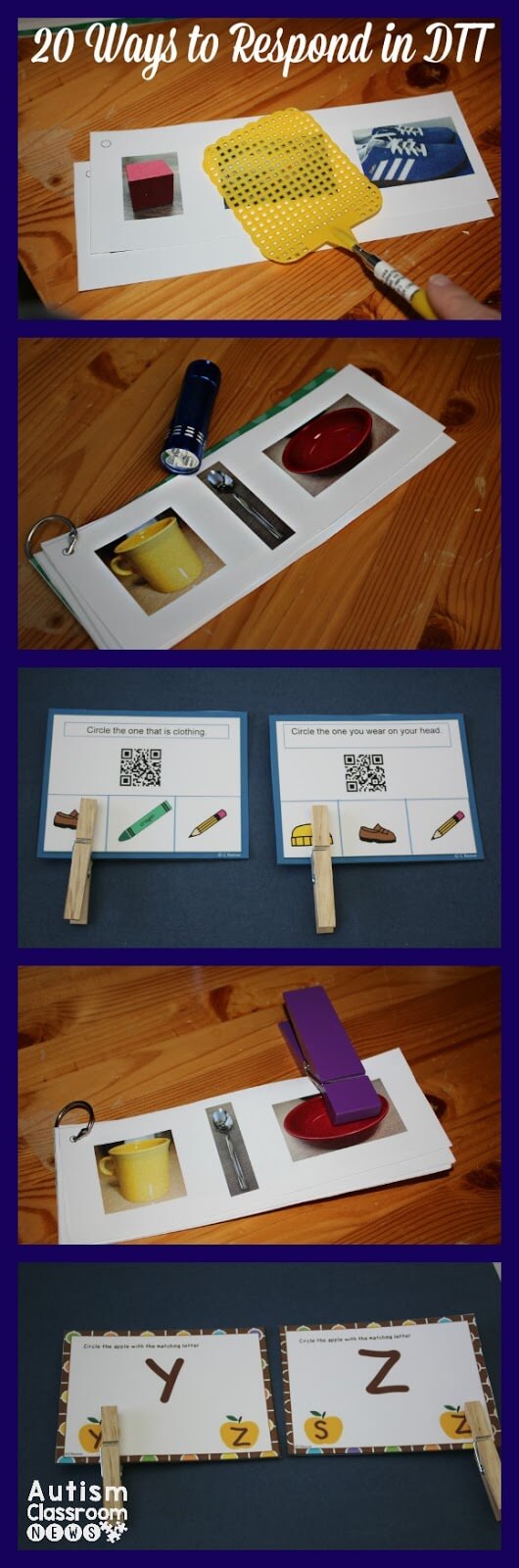
Identifying Cards, Objects or Pictures
1. Swat the answer with a fly swatter ($1 at the Dollar Store–and it’s new–that would be key!)
2. Shine a flashlight on the right answer.
3. Slapping the correct card (Gabrielle from Teaching Special Thinkers)
4. Use a magic wand to point (Traci from The Bender Bunch)
5. Use a pointer (Traci)
6. Put a body part (chin, elbow) on the right answer
7. Put a clothespin on the correct answer (the purple one in the picture is a BIG one they really like) (Gabrielle)
8. Put a bingo marker on the right answer (Gabrielle)
9. Use a dry erase marker to circle the right answer
10. Use tongs to pick up the right card and give it to you (Gabrielle)
11. Drive a race car over the right answer (Gabrielle)
12. Put the cards on the floor and stomp on the right one (Traci)
13. Put the cards on the floor and have them jump on the right answer (Nicole from Adventures in the ATC)
14. Put the cards on the floor and have them jump from the right answer to the next right answer.
Sorting or Matching Items
15. Put cards in piles on the floor and have the student use a scooter to transport them to the matching pile (Pamela from Mrs. P’s Specialties)
16. Have each set at a different station or a different person and have the student take the matching card to the right person/station
Writing Items
17. Have them write in shaving cream (e.g., show them a number and have them draw the number of items in the shaving cream on the table) (Pamela)
18. Have them write on the table or desk with dry erase marker (it messes with their minds to be able to do that!)
Expressive Items
19. Have them answer using a microphone (you can find an echo mike in the Dollar Store; Traci)
20. Have them sing the answer in a funny voice (Traci)
This is certainly by no means an exhaustive list and I would love to hear more answers. Please share in the comments or on Facebook / Instagram (tag me @autismclassroomnews) and I will add them to a list. Then I will make a downloadable PDF that is “prettified” as a friend of mine puts it, and it can be posted as a reminder of ways to shake things up.
You can click on the pictures below to see the products that are used in the picture of the examples.
Until next time,