

I know figuring out error correction and errorless learning can feel overwhelming. Should you correct every mistake? Prevent errors altogether? Try something in between? The research tells us it depends on the skill and the student. Let me show you what your options are.
Table of Contents
At a school where I used to work, we used to have long and academic discussions about minuscule parts of behavioral procedures. To assure consistency across the staff, we had set procedures for how discrete trials were done (among other strategies) and they soon became rules that were expected to be followed.
Now, this is great for uniform application across the school. It’s not so great for making little adjustments to suit the needs of individual students. That’s not to say we didn’t individualize–not at all, we did lots of individualization. However, every time we wanted to change from the standard procedure, we ended up having to convince someone on the team that it was OK to do something different (see it’s not only the individuals with autism who can be rigid) :).
One of the debates that we would often have about changing was on how to handle errors in discrete trials. So today I want to share some of the things I’ve learned and what research tells us to help you make decisions about what strategy suits your learner.
Understanding Error Correction vs. Errorless Learning
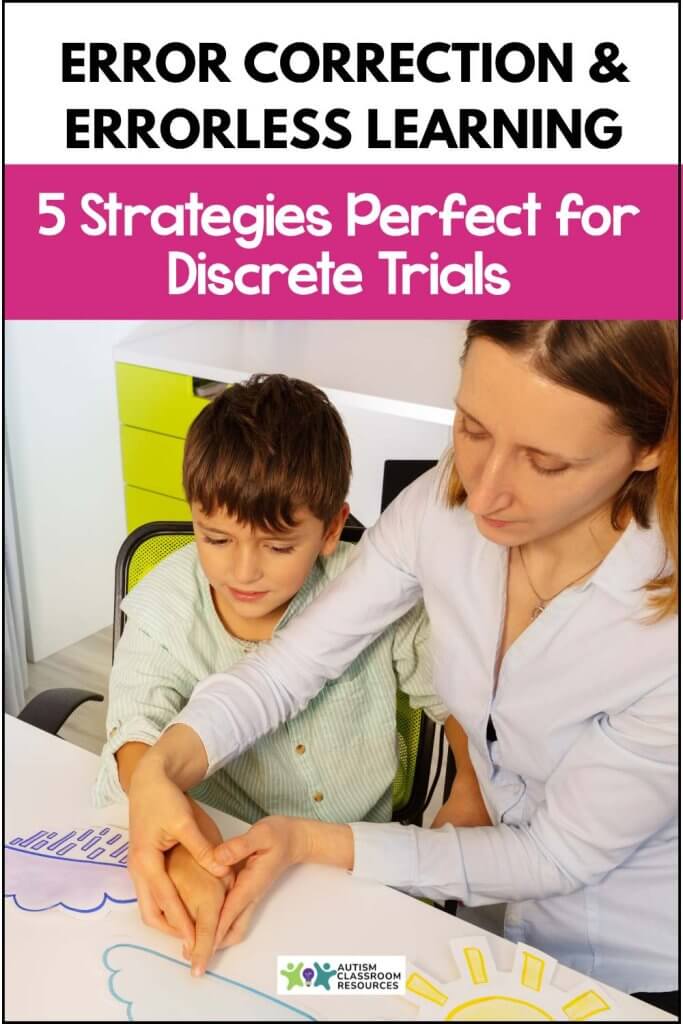
Error correction and errorless learning are critical components of systematic instruction. We often talk about them with discrete trials, but we need to use these strategies anytime we’re teaching systematically—whether that’s sight words, receptive identification, matching, or basic skills.
Here’s what you need to know upfront:
Error correction involves letting students make mistakes and then showing them the correct response.
Errorless learning prevents mistakes from happening in the first place by using prompts that you gradually fade.
Both approaches have their place. The key is making sure your approach actually helps students learn the right answer, not just that they got something wrong.
There is some research that error correction is more efficient than errorless teaching for many or most students (Leaf, Sheldon, & Sherman, 2010). But you still need to watch your data to see how your students respond.
The Problem with Just Saying “No”
Our students are not great problem solvers most of the time. Simply telling someone they got the wrong answer usually isn’t sufficient for them to learn the right answer.
So whether we’re correcting errors or using errorless learning, we have to ask: How are we making sure they get the right answer more frequently? That’s how their answers get reinforced and how they learn the skill.
Error Correction Strategy #1: The No-No-Prompt Procedure
Let’s say you’re presenting two pictures to a student—broccoli and burrito. You say “give me broccoli” and he gives you burrito. Obviously that’s incorrect.
Here’s how the no-no-prompt works:
“Show me burrito” (student points to broccoli). No.
“Show me burrito” (student points to broccoli). No.
“Show me burrito” (you give an immediate prompt to the burrito picture).
Then you’d present several more trials of the burrito alone or with the burrito maybe placed closer to the student in a positional prompt. The student needs those repeated correct responses with reinforcement to actually learn the discrimination.
Error Correction Strategy #2: Single Correction with Breakdown
Sometimes you correct the error once and then break it down to make it easier. If you’re presenting two or three items in an array on the table, and your student gets it wrong, you say “No,” then present just that right answer so he gets it right. “Yes, that’s a burrito. Good job.”
Then maybe break it down into just two choices. If you see him going for the wrong answer, cue him to get the right answer.
Then, here’s the important piece: give him distractor trials. These might be things like “Touch your nose” or “Do this”—simple one-step directions you know he can do. You’re not recording data on these trials. You’re just building them in to distract him so you don’t get a practice effect.
But you’ve always got to come back to that same array level where you started. If you began with three pictures, your data needs to reflect that array.
Error Correction Strategy #3: The Silent Correction (No Verbal Feedback)
You may have a student who gets answers wrong, and you know (from your data) if you say “no” to him, he’s going to start chucking materials at you and you’ll lose his engagement.
Here’s what you do: “Give me burrito” (he gives you broccoli). You just pick it up without saying anything. “Give me burrito” (you give him a positional prompt so he gets it right the next time). “Yes, burrito. Nice job.”
You might do it one more time with the positional prompt because it’s closer to him. Then throw in a distractor like “match popcorn” or “give me this one.” Then put your three items out again and hopefully you’ve practiced enough that he can give you the burrito.
This approach lets you correct without the verbal feedback that triggers behavior.
Errorless Learning Strategy #1: Positional Prompts
Errorless learning is where you’re using some kind of prompt to keep the student from making a mistake and gradually fade your prompting out. Usually it means you’re going to do more trials because you’re doing a ton of prompted trials before you get to an independent trial.
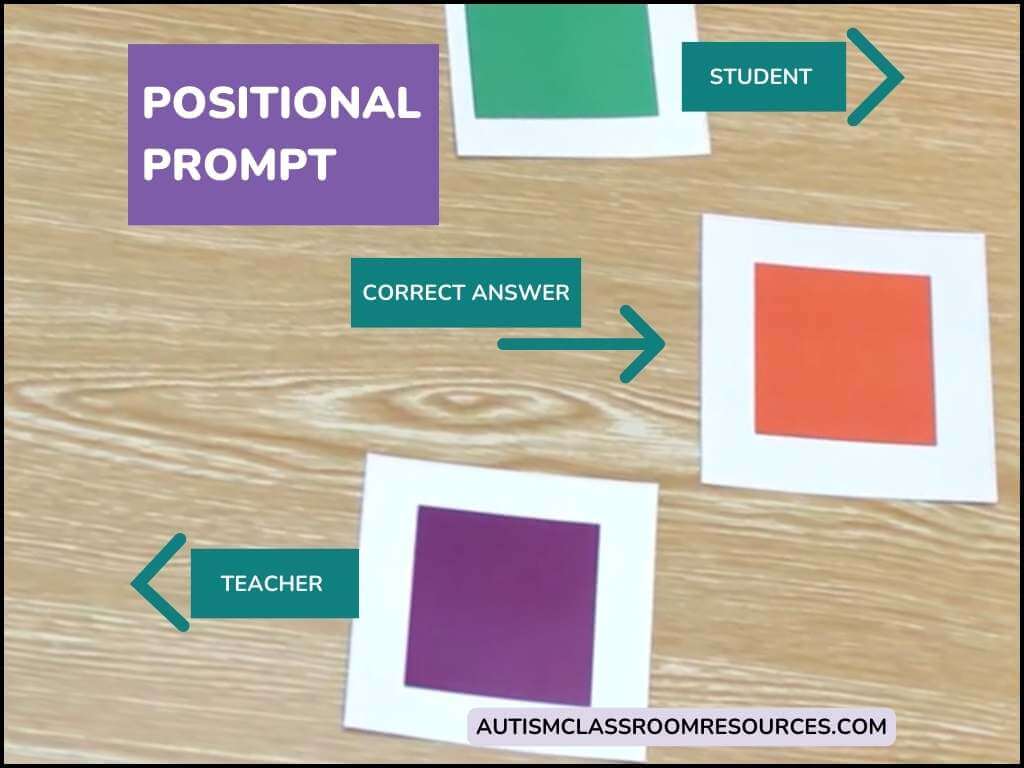
For instance, you can use errorless learning with positional prompts by putting the correct answer closer to the student and then fading it back into the array. “Give me orange” (orange is closest to her). “Yes, orange.” Then you gradually move orange back until it’s in line with the other options.
This errorless learning approach typically results in less problem behavior because students are getting lots of right answers. It’s also fairly easy to do because you can give prompts in different ways and use positional prompts to fade them out.
Errorless Learning Strategy #2: Probe-Then-Prompt System
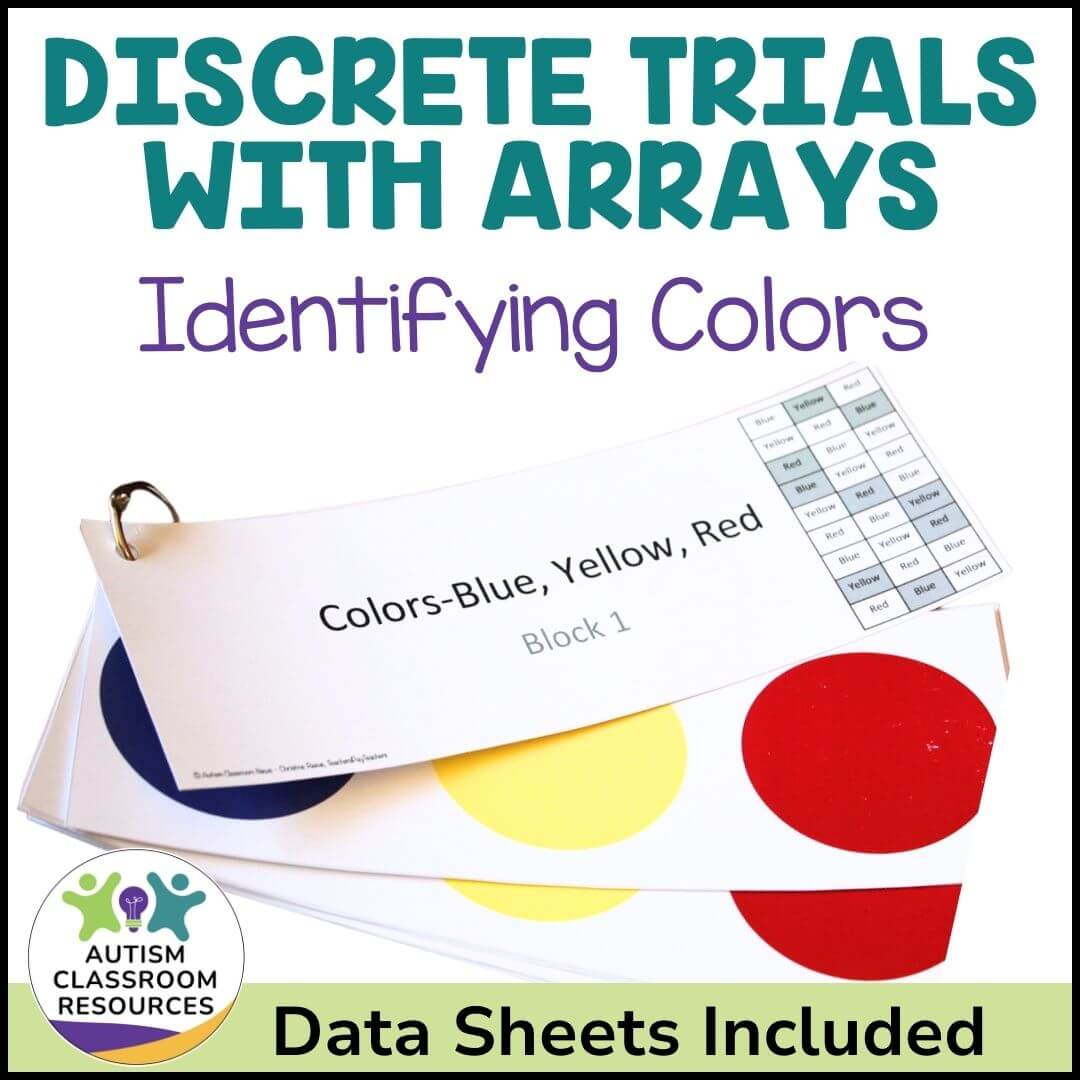
This errorless learning approach is great if you’re giving trials to paraprofessionals to implement or need something very systematic. Present each item once in different positions and look to see what’s the most intrusive prompt the student needed to get the right answer.
“Show me block.” “Show me shoe.” “Show me car.”
Then when you do your nine trials with your arrays, you use that same level of prompting every single time. If he needed a gestural prompt when you did the probe trials, every time you present these items, you point to the correct answer.
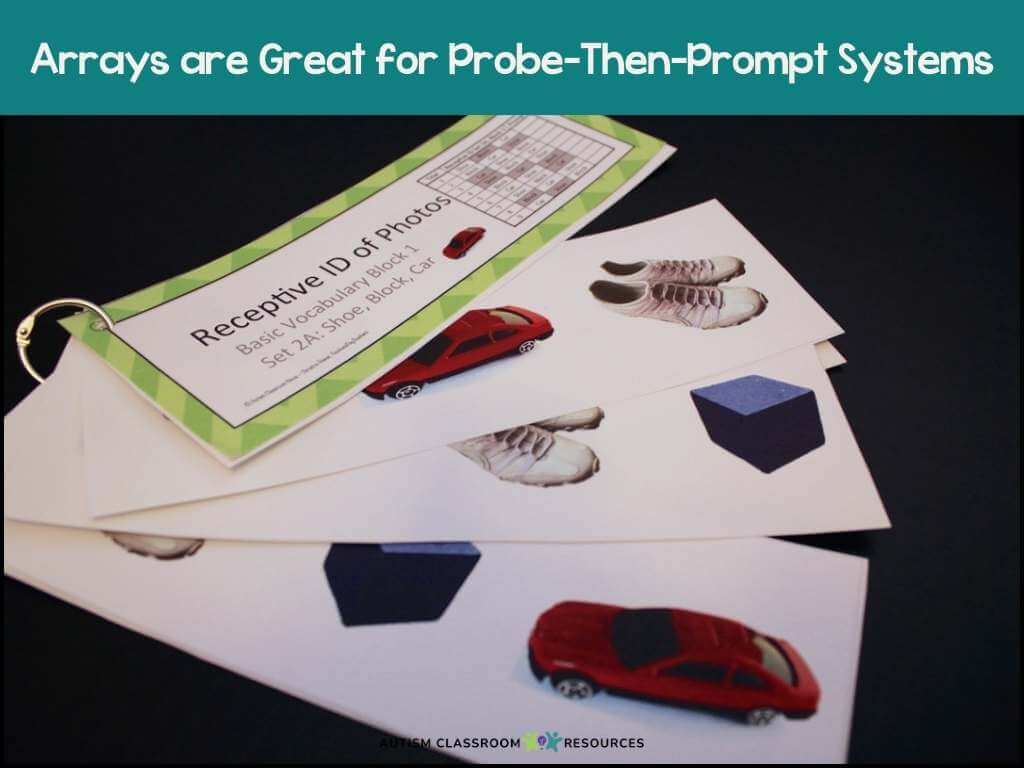
This errorless learning system is going to take a bit longer, but it’s easier to implement if you’re giving the strategy to someone else to do. They just have to implement it exactly as you’ve laid out, and then you look at the data.
Discrete Trial Training
These DTT Kits
Use the Probe-Then-Prompt Strategy
Why Mix and Vary Is Your Secret Weapon
The mix-and-vary component is really important whether you’re using errorless learning or error correction. We don’t give students burrito, burrito, burrito, burrito unless we’re doing that intentionally.
You can use those simple one-step distractor trials I mentioned—easy things because you know the student will engage with them and you know they’re likely to get them right. So you can reinforce them and the mixed trials serve to distract them.
You can also give them a different kind of task altogether. Maybe you put burrito away for a minute and switch to sight words. Do some matching tasks you know they can do. Then come back to your target skill.
In Pivotal Response Training (PRT) we talk about mixing in 50% mastery trials. That’s kind of what we’re doing here. It keeps students engaged and reduces frustration from being stuck on one hard thing.
Watch Out for Prompt Dependency in Errorless Learning
If you’re using errorless learning or having difficulty fading prompts, you may have a student who becomes dependent on the teacher’s response. They become that kid who holds out their hand and waits for you to physically prompt them to the right answer.
We call that “prompt dependence,” but really the problem lies with us figuring out our instruction rather than the student.
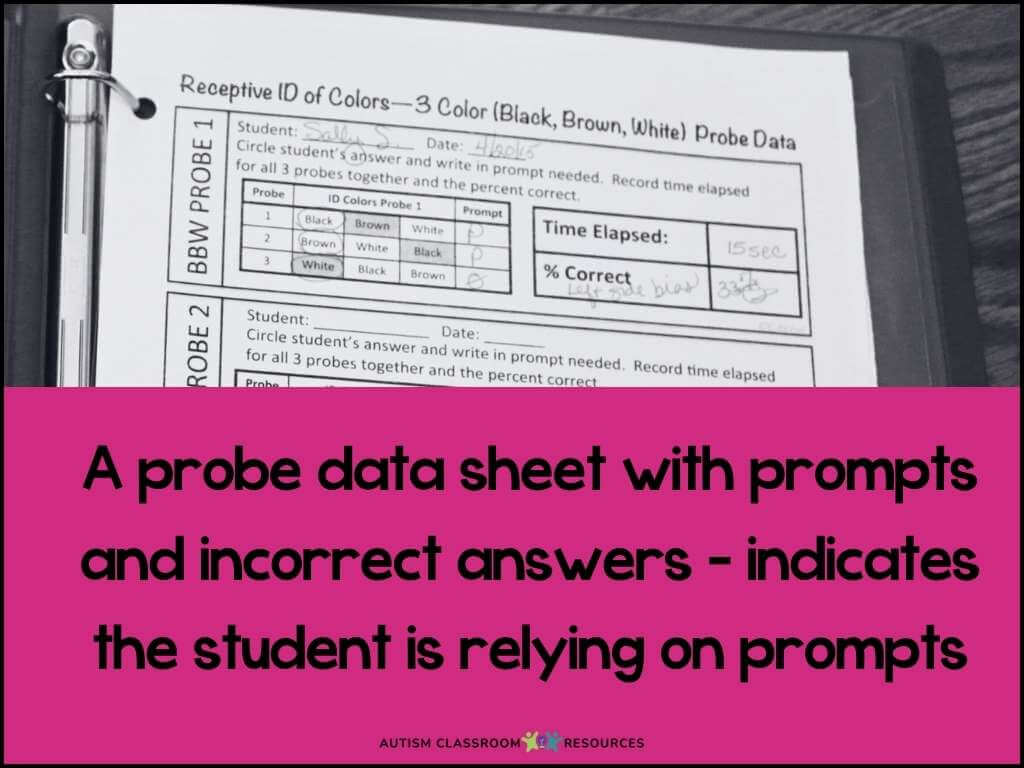
They aren’t learning the discriminations you’re trying to teach. Instead of learning to read the sight words you’re presenting, they’re learning to watch your reaction and wait for the prompt. They are attending to the wrong cues. And then you’re going to have to go back and unteach it and teach it again. Students with autism in particular are susceptible to this because of their difficulty screening out stimuli.
If you’re seeing a ton of prompting in your data, that’s a good sign you may need to use a different procedure.
Why You Can’t Just Mark It Wrong and Move On
If we don’t correct errors or address them in some planful way, we end up with a student who we say, “Show me banana” and he shows you butter and you mark it wrong. “Show me cheeseburger” and he shows you butter and you mark it wrong. He never learns what those things actually are.
The prompting in errorless learning, and sometimes the error correction or error prevention, is part of what allows him to get it right so he gets reinforced. That reinforcement is driving the learning, but your prompting is allowing him to get to that point.
We can’t just let the errors go and count them wrong because he’s just going to keep getting them wrong, and wrong, and wrong, and he’s not going to progress.
Looking for More Support with Discrete Trials?
Check out the discrete trial programs below. They are designed to put materials in arrays with each position represented. They are great for giving paraprofessionals discrete trials because the materials and instructions are all laid out (that assumes you have taught them about prompting, reinforcing, etc.).
Now that you understand the different strategies, you need to know when to use each one. Check out the companion post on how to decide between error correction and errorless learning for your students.
Discrete Trial Training
These DTT Kits
Use the Probe-Then-Prompt Strategy

![Summer resources to help survive the end of the year in special education [picture-interactive books with summer themes]](https://autismclassroomresources.com/wp-content/uploads/2018/05/SUMMER-RESOURCES-ROUNDUP-FEATURE-8528-768x768.jpg)