
Summary: This post shares 9 practical tips for writing IEP mastery criteria that actually work in your classroom. I’ll walk you through how to choose the right mastery level based on skill type, importance, and practicality—plus show you how to avoid common pitfalls that create data collection nightmares. You’ll learn how to write mastery criteria that make sense for your teaching plan and keep your IEP team on the same page.
Table of Contents
Why IEP Mastery Criteria Matters More Than You Think
IEP mastery criteria is the unsung hero (or dastardly villain) in IEP writing. We don’t think about it nearly as much as we probably should. And there are so many ways it can help us or hurt us down the road as we’re actually trying to teach the skills from the IEP.
It’s so easy to have a standard, like slap on 80% or 4/5 on the end of the goal and call it done. But the mastery level can be one of the biggest areas of disagreement when determination of mastery comes around. That’s because we sometimes write IEP mastery criteria for goals in a way that means different things to different participants.

IEP mastery criteria is also critical when you create your system of data collection. There’s nothing worse than sitting down to analyze your data, only to discover it doesn’t match the way the mastery criteria was written.
I’ve taken data for many years of lots of students’ where I wrote the goal and I didn’t, so I’ll be the first to tell you that many of these lessons were learned the hard way. You can read more about writing IEP goals here.
1. Match Mastery Criteria to Your Type of Skill
The first consideration in IEP mastery criteria is the type of skill the goal is addressing. Different skills lend themselves to different types of mastery. And even within the subject or area of the skill, you could have different needs for mastery.
Reading
Reading lends itself to accuracy of comprehension at different grade levels. But it also needs to focus on fluency of words per minute and accuracy of words read. So depending on the focus of the goal, you could be writing percent accuracy (e.g., percent of comprehension questions correct) or words per minute in a second-grade paragraph. And then it’s important to remember that the grade level or difficulty of the work may need to be specified in the goal as well.
Math
Math lends itself to accuracy (e.g., 90% correct) in most situations. But sometimes we need to think about fluency (e.g., x problems per minute) with math facts. And again, in both situations, we need to specify in the goal the level of work they are completing at that accuracy or rate. That becomes part of the mastery.
Challenging Behavior
Challenging behavior is often measured by frequency over time (e.g., no more than 1 instance of hitting adults per week). However, if I was measuring crying, I might need to have mastery as duration. Because crying for 60 minutes one time a day (frequency=1) is more significant than crying 10 minutes each time for 3 times a day (frequency=3).
And if the problem was the severity of the behavior, we would need different measures like rating scales.
2. Consider the Importance of the Skill
You have to choose how high you set your IEP mastery criteria based on how important mastery of the skill is to the student. The importance of the skill has several facets–such as how pivotal it is to learning, how important it is the to the IEP team and/or student, etc. We need to think about the importance of the skill to later learning and to safety and well-being.
Foundational Skills
Is it a basic skill that’s foundational to later skills? For instance, reading decoding, fluency, and comprehension are pivotal skills in being able to read for knowledge later. Because of that, early reading goals that focus on basic reading skills need to have higher levels of mastery.
Mastering decoding at 60% is going to be problematic as the student’s independent reading becomes a foundation for learning new material.
Similarly, if it’s following simple directions, that’s a skill we use throughout all of our teaching, so not mastering that with a good amount of accuracy and fluency is going to hinder later learning.
Safety and Well-Being
Skills that involve safety or well-being require higher levels of mastery. For instance, crossing the street needs to be mastered at 100%. If a student masters it at 80%, he has a 20% chance of not checking and being hit by a car.
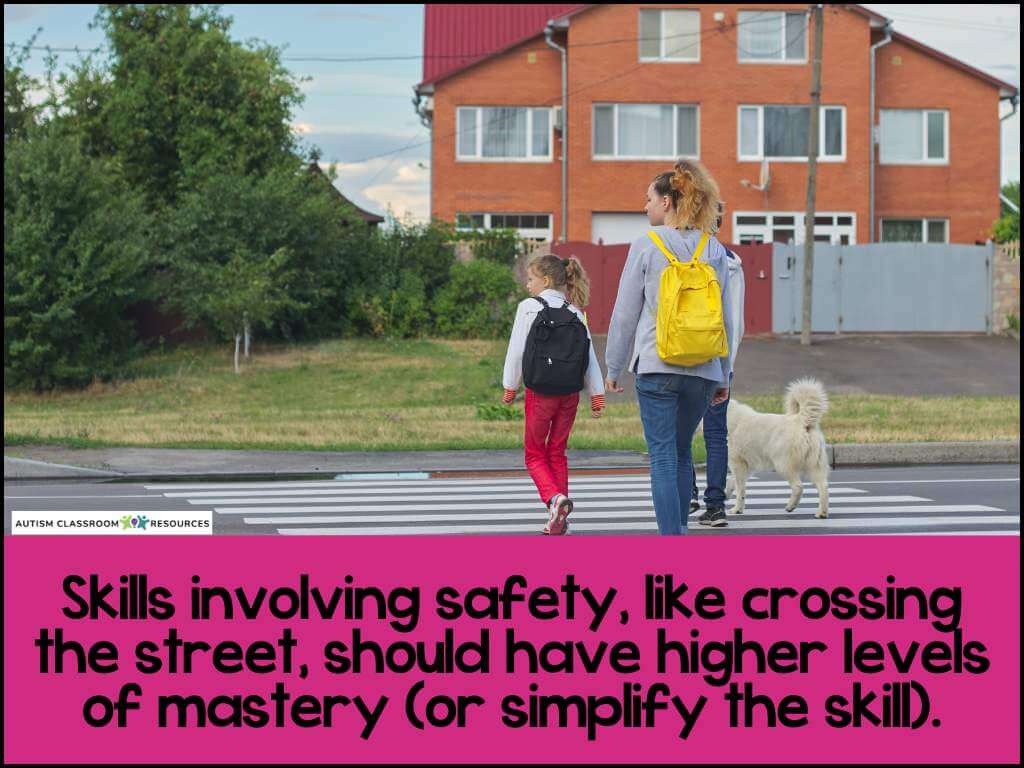
Let’s say we’re writing a goal for lab safety in chemistry. Having a student using a bunsen burner safely isn’t something that we could have at 60% accuracy.
3. Keep It Age-Relevant
You have to set your IEP mastery criteria based on whether it’s meaningful for the student’s age. For instance, saying that a student will be on-task in a group situation 100% of the time is probably not realistic for most ages. We all are distracted at times.
Similarly, if a typical peer responds to questions with correct answers 70% of the time, it’s not reasonable for a child with an IEP to do it at 90%. Pay attention to how often behaviors occur in typical students and use that as your guide.
This becomes critical to think about with behavior. If you are measuring how well a student follows directions the first time they are given, pick a neurotypical peer of the same age and measure how well they would do in similar situations. Then use that as your criteria.
4. Think About How You’ll Measure the Skill
Educators often lock themselves into a really complex data system because of how the IEP mastery criteria for the goal is written. Think about how you will measure the skill BEFORE you write the goal or you will regret it.
I cannot tell you how many times I’ve written a goal and then had to throw it out the first time we tried to take data….because we didn’t think about whether someone could pay attention enough during an activity to take the data, or there was no way we could run the activity and count every repetitive phrase.
![Behavior Data Sheets: PowerPoint and Google Slides; add student information; 6 types of data collection; 36 variations of data sheets [picture behavior intensity rating scale with data collected]](https://autismclassroomresources.com/wp-content/uploads/2022/06/Behavior-Data-Sheets-Cover-6-2-25-300x300.png)
The Problem
Sometimes the problem is how we measure the goal; and sometimes it’s about having a reasonable way to take the data that gets the information we need without spending all our time looking at a clipboard.
For instance, you’re writing a goal to focus on a student improving initiating communication or social interaction. You write a goal that he will initiate a social interaction with a peer on 4/5 opportunities. But when you go to collect data, you realize that you don’t know what an opportunity to initiate that he didn’t take looks like.
A ratio measure or a percentage means that 1. You have to monitor the behavior for the whole time to count opportunities as well as performance. And 2. It has to be something for which you can observe the opportunities.
The Solution
First, figure out your baseline of how many times he currently initiates during an activity like recess. Let’s say it’s between 1 and 2 times in a 15-minute recess time. Then write the goal as: “Stew Dent will initiate an interaction with a peer at recess 3 times during a 15-minute period.”
This way you only need to count the number of times he initiates and not how many “opportunities” he has (that you can’t determine anyway). It streamlines your data and makes it more meaningful. Check out this post for more ways to take IEP data.
Build in Conditions of Measurement
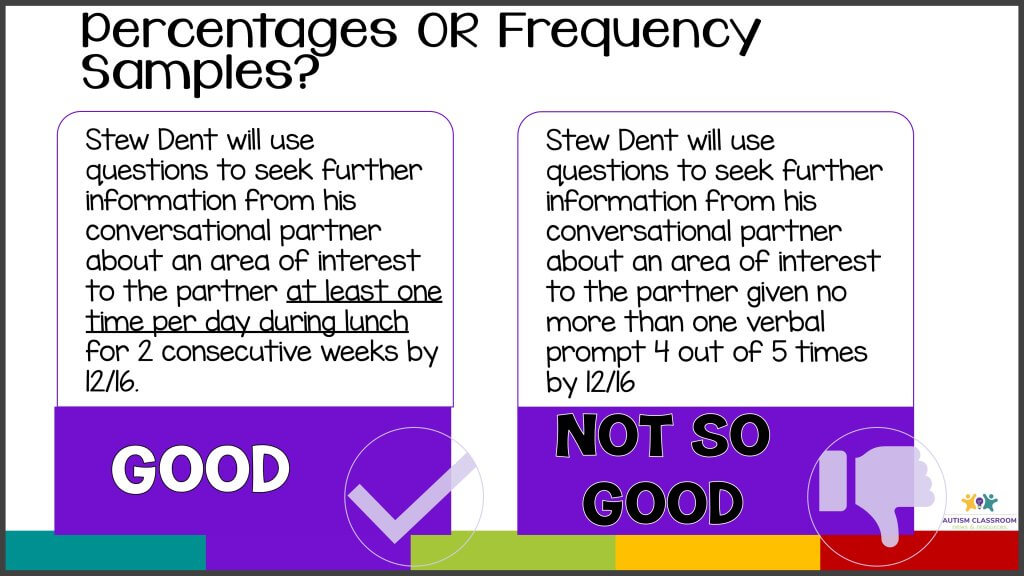
Make sure you’re writing in conditions of data collection in your IEP mastery criteria. For instance, counting every verbalization a student makes throughout the day is going to be difficult and may result in unreliable data. So if you’re planning to assess the skill by taking a weekly sample or probe data, indicate that in your level of mastery.
Instead of writing that he will do it 4/5 days (which means taking data every day), you might write that he will demonstrate the skill on 4/5 opportunities on twice-weekly samples collected over a period of 3 weeks. Then you take a sample twice a week and use that data.
5. Align With Your Instructional Steps
Make sure you’re thinking about your instructional steps—the order in which you’re going to teach the skill—before you write the goal. This is one I learned most recently and it’s been a game-changer.
The Problem
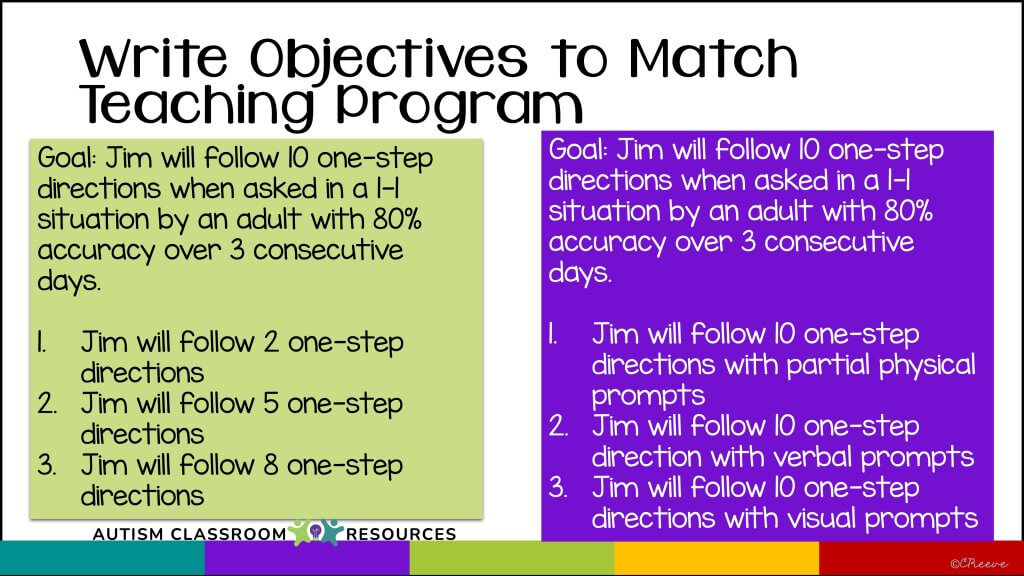
Let’s say you’re teaching one-step directions by introducing 1 direction, then a second direction, and then randomizing them. Then introducing a third direction and randomizing all of them. If you write your objectives based on prompting levels, you may have only introduced 2-3 directions by the time you need to report progress. So you’d have to test the student on directions that haven’t even been introduced.
The Better Way
Write the goal with objectives like this:
- GOAL: S. will follow 10 one-step directions independently on 8/10 opportunities.
- S. will follow 2 one-step directions independently on 9/10 opportunities.
- S. will follow 5 one-step directions independently on 9/10 opportunities.
- S. will follow 8 one-step directions independently on 9/10 opportunities.
That way if you write the goal by prompt level, you might not be using that prompt but only have learned 3 one-step directions. Also, you don’t run into issues with it clashing with the way you’re going to teach the skill.
6. Write Practical Mastery Criteria
Make sure to write your IEP mastery criteria so it’s practical to measure. If you have a student working on walking independently, use criteria like “John will walk to the bathroom from his work station independently.” This is much easier to implement than “John will ambulate for 25 feet independently.”
Please don’t make me measure the distance to see whether the skill was just demonstrated. Pick practical elements of the environment that you can use to measure and build them into the criteria.
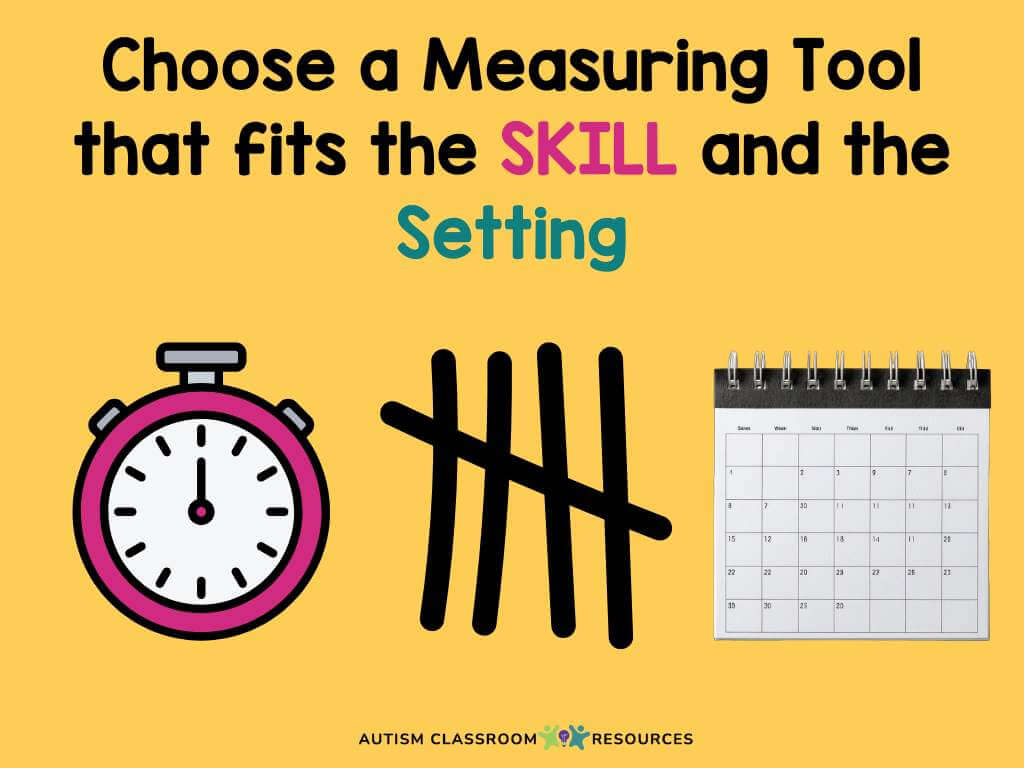
Similarly, create your mastery criteria so it’s practical given the student’s previous learning and performance. So while it’s tempting to say 2nd grade reader will be on the the fifth grade level by then end of the year…if last year he only learned 30 sightwords for the whole year, that goal is not meaningful.
7. Include a Time Frame for the IEP Mastery Criteria
You want to make sure you’re including a time frame in your mastery criteria. Here’s why this matters so much.
I once was working with a student who was making great progress. But when we sat down with the parent for a quarterly meeting, the teacher averaged all the data for the 9 weeks together. She was averaging his performance when we started teaching the skill with his performance at the end when he had met mastery criteria. Essentially she was averaging the pre-test with the post-test, which washed out his performance increases.
Mom insisted that it had to be an average of all the data across the IEP because of the way we had written the goals (without a time frame).
How I Write It Now
“Jimmy will follow a 1-step direction presented in a small group independently on 90% of the trials over a 2-week period.”
This goal tells us we’re going to use the data from a 2-week period and he needs to independently follow the direction on 90% of the opportunities when accumulated over that time. I don’t need 9 weeks of data. The 2-week period just keeps rolling until mastery is achieved.
This also assures that the mastery of the skill wasn’t a 1-time thing and that the student is likely to maintain the skill longer.
8. Make Mastery Criteria Meaningful
We need to make sure our mastery levels mean something. Let’s assume you expect that a student will not be able to master a skill at 75%, and you’ve determined that typical students would display the skill at that level. In this situation, I strongly suggest you reduce the skill (change to an easier skill) rather than the mastery.
Mastering something at 50% is not really meaningful—it’s hit or miss. So instead, add prompts or have them master a subset of steps rather than lessening the level of mastery. Change the goal instead.
Most of the time I would rather make the goal easier and master it more strongly so we can move on to more advanced skills.
9. Discuss IEP Mastery Criteria With Your Team
It’s always a good idea to have a discussion with the IEP team about the IEP mastery criteria. Have those discussions early on so you don’t run into issues down the road. You don’t always know how interpretable things are until you get feedback from others.
You want to make sure all team members believe the goal is appropriately and challenging but attainable. These conversations up front can save you from disagreements later when it’s time to determine if a goal has been mastered.
Ready to Write Better IEP Goals?
I hope these 9 tips help you write IEP mastery criteria that make data collection easier and keep your team on the same page. Remember, the key is thinking through how you’ll teach and measure the skill before you finalize that goal.
Looking for more help with IEP goals? Come join us in the Special Educator Academy with a free trial. We have a whole IEP writing bootcamp with tons of tools to help you write measureable goals. And we have an IEP goal bank you can use to get ideas.