
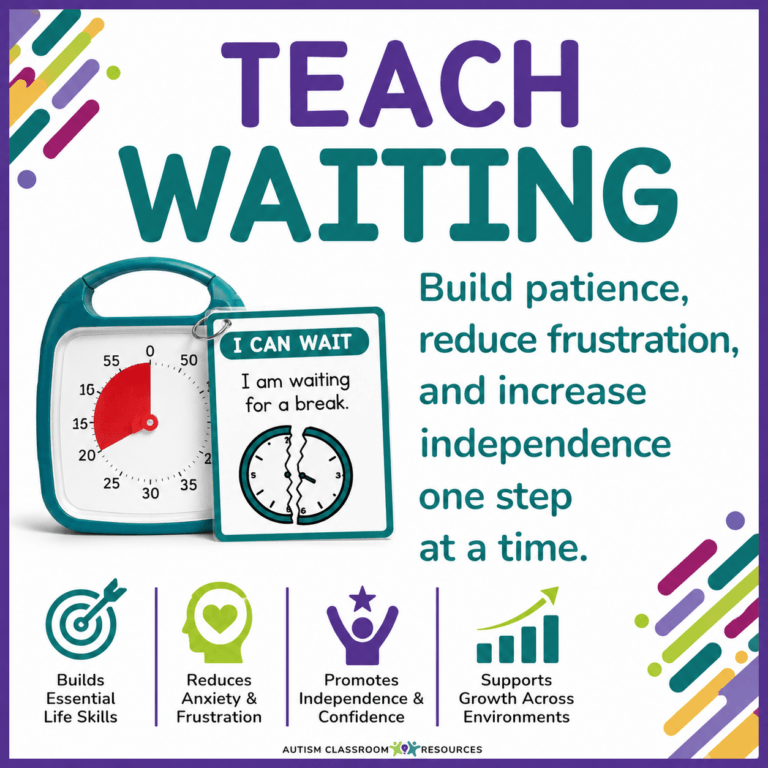

One of the questions I get asked frequently is what are the best ways for teaching waiting skills as a replacement behaviors for challenging behavior. Wait time comes up in a variety of situations.
There are times that we all just have to wait in our own life. We have to wait in long lines, wait for our food at a restaurant, we have to wait for what we asked for, and wait and wait and wait…it seems at times.
We also need to teach waiting skills for gaining attention. This is a later step in functional communication training for attention-seeking behaviors. Because believe it or not, we can’t attend to this student every minute of the day. Nor does that happen in regular life based on my own experience.
Table of Contents
First Steps in Teaching Waiting Skills
Just like we teach everything else…teaching waiting skills begins with breaking it down into small segments, present them systematically, and reinforce the best possible outcome. There…job done, right? Probably not so much…so let me give you an example of what it looks like.
Break down how to wait into teaching steps
Breaking down waiting means starting at a short time to wait. If you are teaching waiting skills as part of a behavioral program of FCT, in particular, you want to start at waiting for a second. I mean literally a second. In order to believe that “Wait” means you will get back to the student with attention or what they asked for–or whatever they are waiting for. So to teach them that, the wait has to be very short period of time.
So, let’s say we want to teach Bruce how to wait for something he has asked for. Bruce has learned to ask for things, but expects everything he has ever asked for immediately. When something isn’t immediately available, he starts to show a variety of challenging behaviors. So, to teach him how to wait for something, his teacher decided to start by having the waiting period start at 1 second.
So the exchange went something like this:
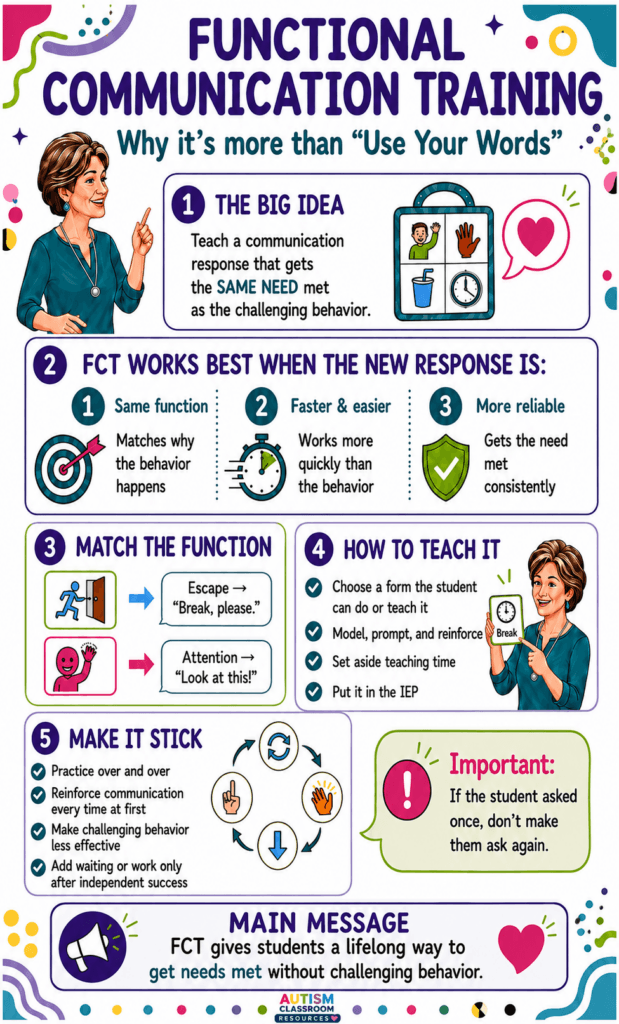
Bruce asks for something.
The teacher says “Wait” and gives him a wait card.
She then IMMEDIATELY turns around and gives him what he requested.
Reinforce increasing time for waiting.
Next we need to make sure we are reinforcing waiting effectively when teaching waiting skills. Particularly if the student has behavioral issues related to waiting, you want to start small and go slowly up to a long wait. Think about breaking the waiting time down from immediate, to 2 seconds, then 5 seconds, 10 seconds, 20 seconds, etc.
Make sure to give the student whatever he was waiting for at the end of the set amount of time time, though. That assures you are shaping the student’s waiting. The reinforcement of waiting and the consistency of getting what he wants after waiting is what teaches the skill.
Use Visuals
You won’t always need them, but visuals can be helpful in a variety of ways when teaching waiting skills. And they can be particularly helpful if whatever the student wants can’t be delivered immediately.
Use a waiting visual
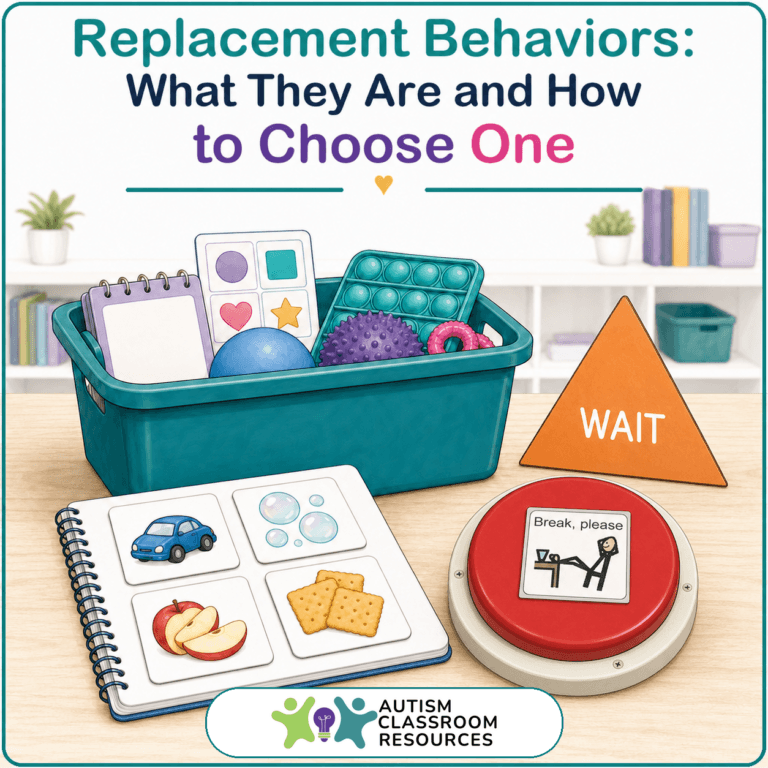
A wait visual helps student’s like Bruce know that you are coming back to them. It symbolizes that “wait” is different than “no.” As waiting time gets longer, it’s also helpful to remind adults that the student is waiting for a long time.
Make sure that the waiting visual looks different than other visuals (a circle or a triangle) so the student can easily differentiate it.
Use Social Stories
Social stories won’t be effective for everyone when teaching waiting skills, but sometimes it helps to introduce the concept of waiting through a social story. You will most likely still have to teach the concept. However, some students do well with social stories and explanations of how waiting will work. So it might shorten the time it takes to increase the time the student learns how to wait.
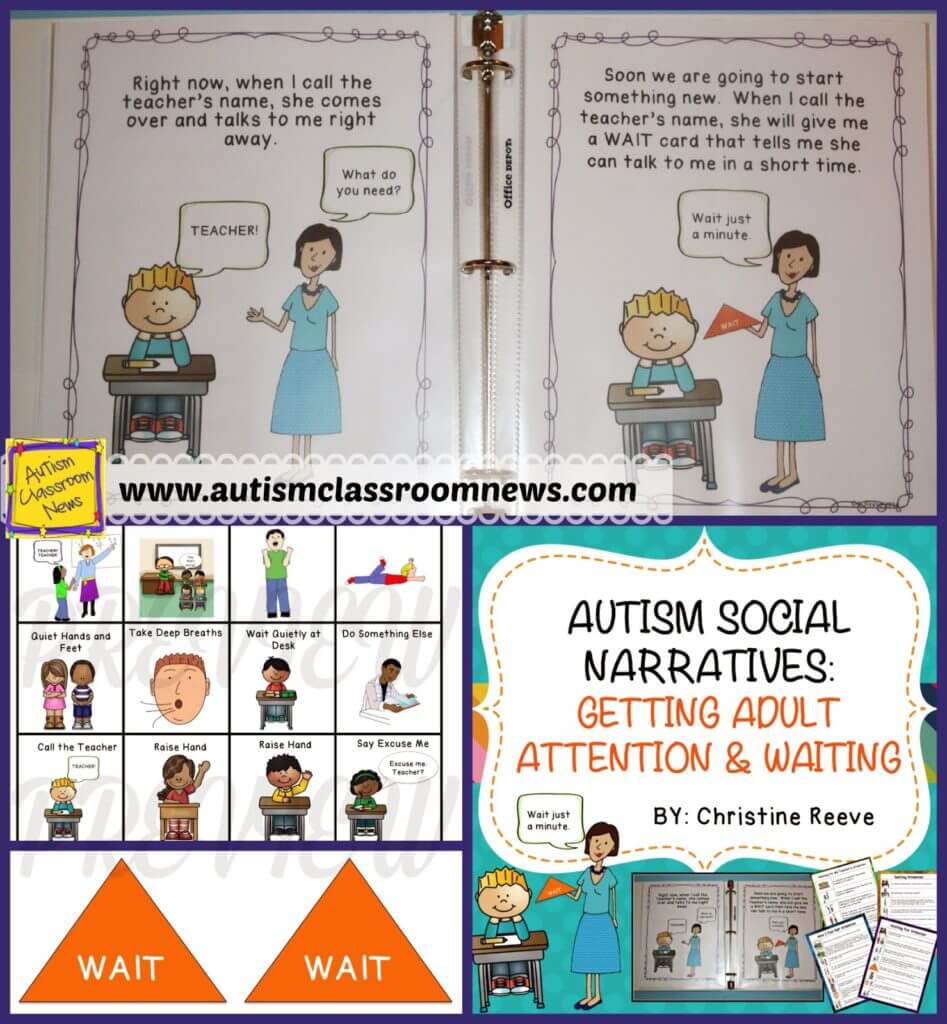
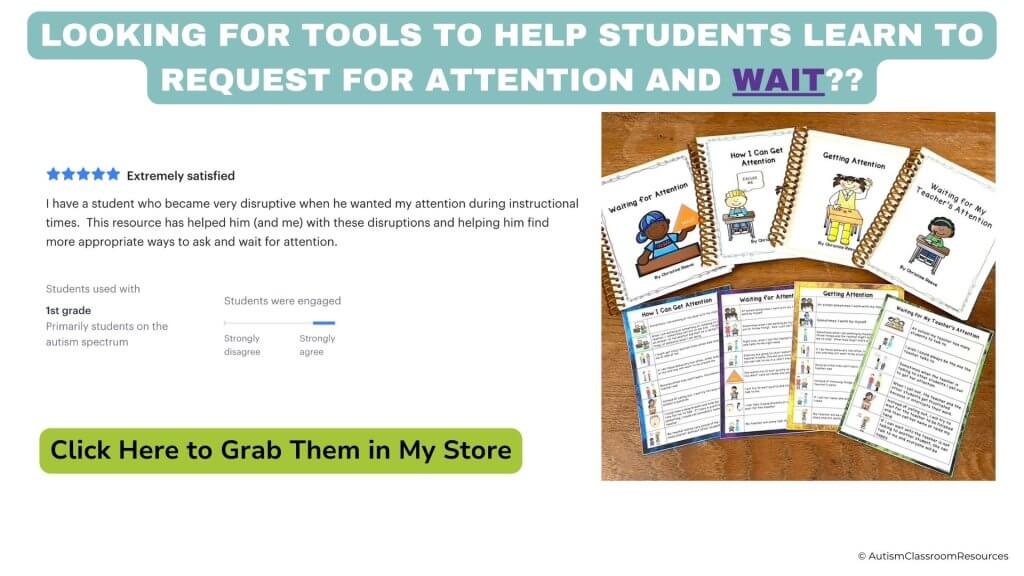
Social stories can be a great tool for teaching students how waiting works. Grab this set with 4 social stories and waiting visuals in my store here.
What if There’s Nothing to Wait for?
There will always be times when you can’t grant a request or attend to a student each time he/she asks. So, what do you do at those times? Try using visuals to teach the student that something is off-limits or not available.
Empty containers.
If the student is asking for something tangible, particularly food, try showing the student an empty container when you ask him to wait. This may help him understand that it isn’t available at that time.
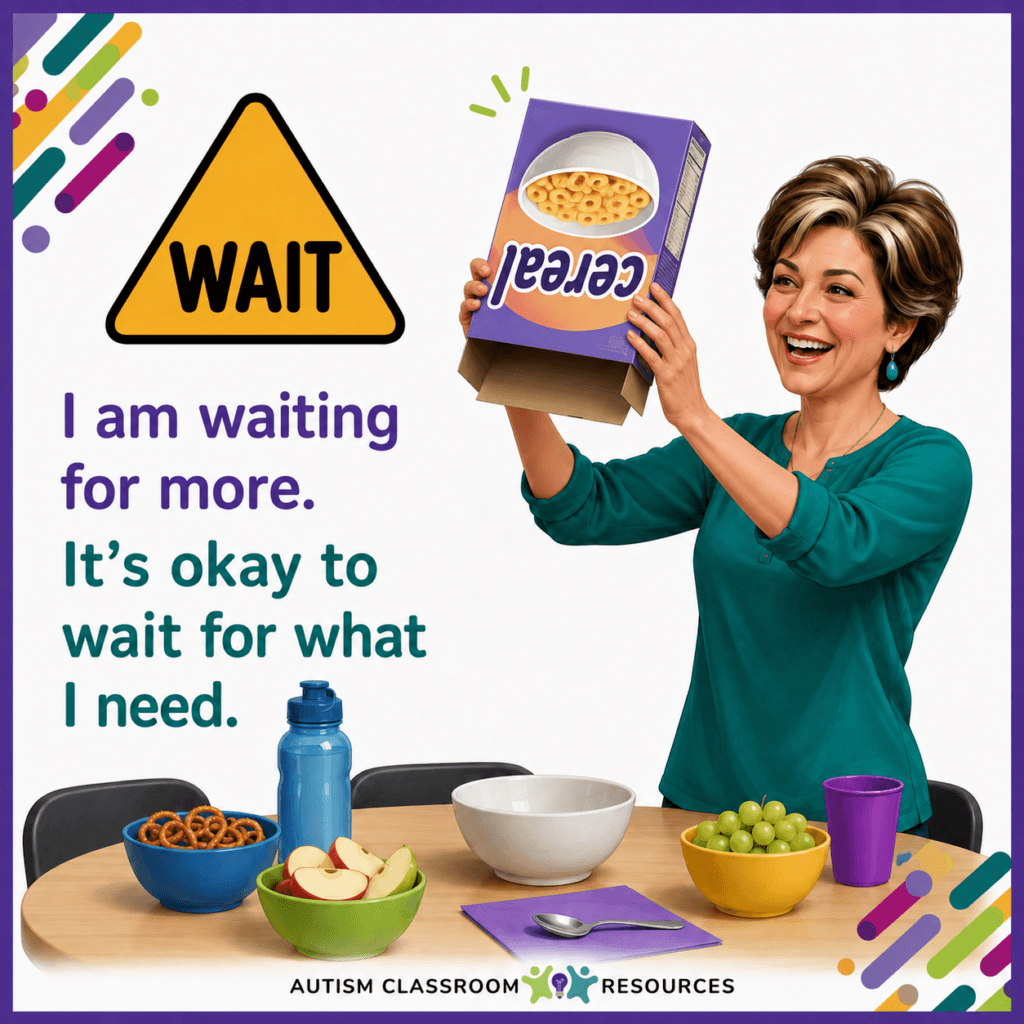
If he can’t have the item at all (e.g., we’re all out of Froot Loops), then don’t tell him to wait, because you won’t be able to get him the thing he wants to reinforce the waiting. Instead, use an empty container or a universal “no” sign to let him know that what he wants isn’t available.
It won’t work perfectly every time, but sometimes it can help explain the stressful situation and reduce the possible behavioral issues.
Want to know more about teaching students to ask for attention and then learn how to wait for attention? Check out this set of social stories in my store to walk you through it.