
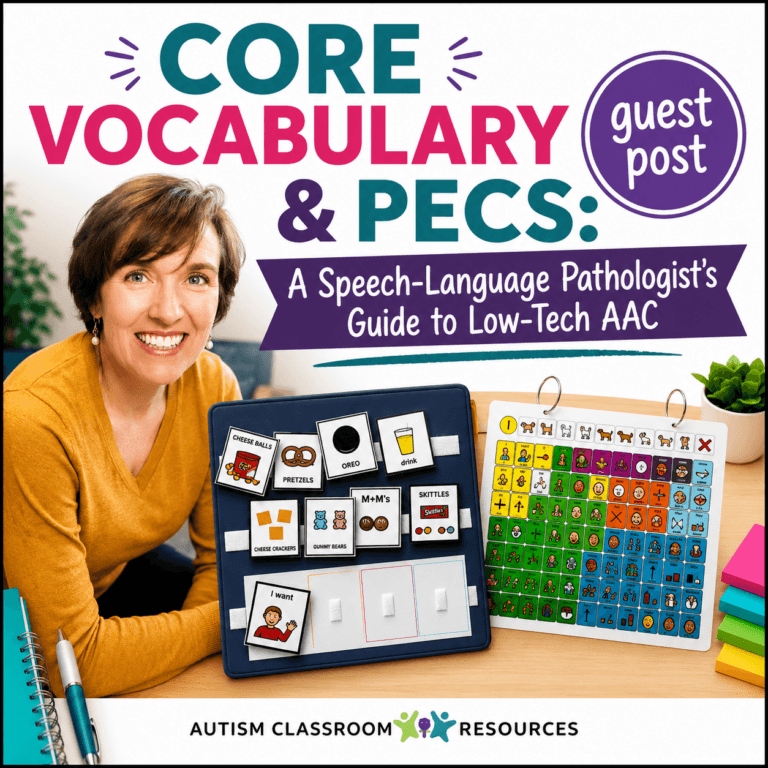

Today’s post is written by a good friend and colleague of mine, Merrie McLean Smithson, M.S., CCC-SLP. Merrie is a speech-language pathologist with 30 years of experience, much of it spent providing push-in therapy in preschool and special education classrooms. I’m excited that she is sharing her wisdom about the Picture Exchange System and Core Vocabulary. You can find out more about Merrie and grab a freebie at the end of the post.
What’s Inside
When considering AAC options for children with language delays, special educators and speech-language pathologists often ask the same question: What’s the best low-tech option — PECS or Core Vocabulary?
Both are well-researched, evidence-based systems, and both can be wonderful tools for a nonverbal or minimally verbal student. But they work in very different ways, and one may fit your student and classroom far better than the other.
Today, I want to focus on Core Vocabulary — what it is, why I love it, and when I recommend it. I’ll also give you a quick rundown of PECS and how the two compare, so you can decide which approach makes the most sense for your situation.
A Brief Overview of PECS
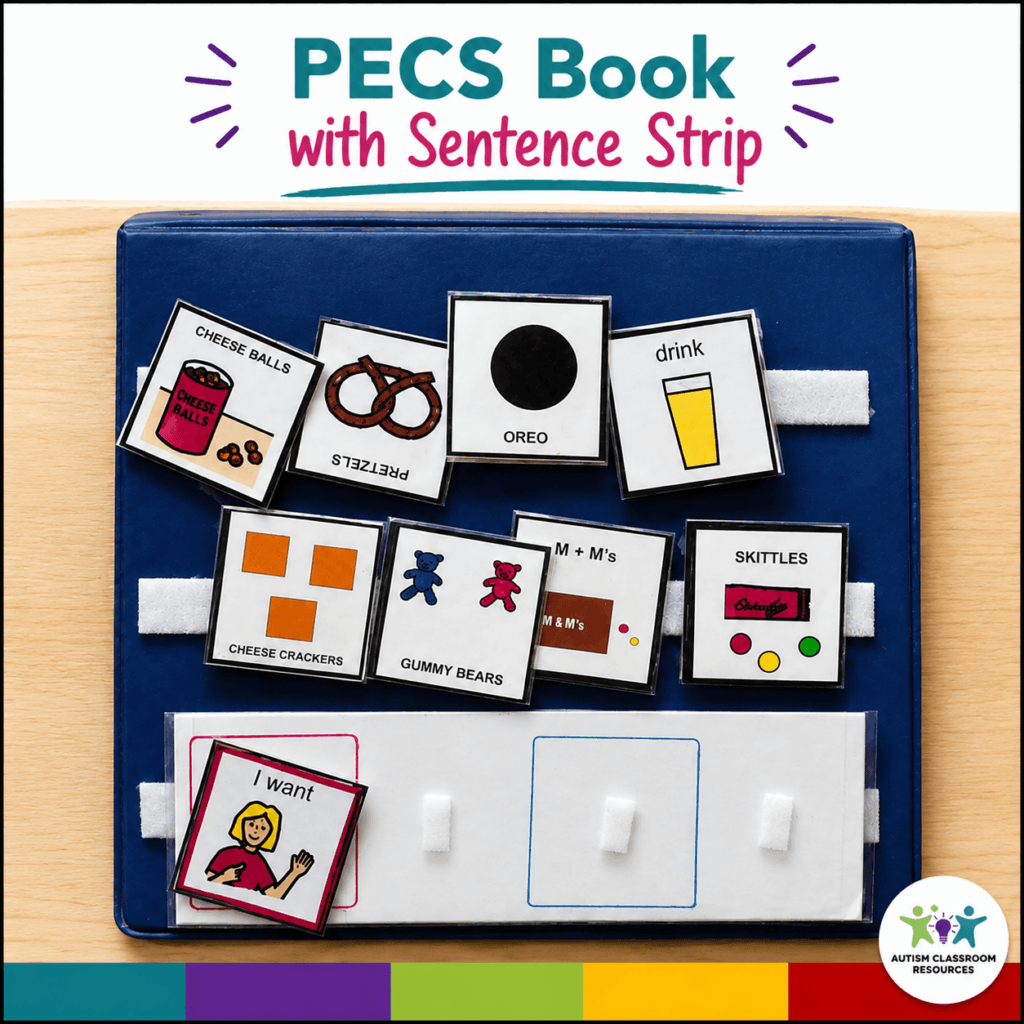
The Picture Exchange Communication System (PECS) was developed by Andy Bondy, Ph.D., and Lori Frost, M.S., CCC-SLP, originally for preschoolers with autism. A student learns to hand a picture of a desired item to a communication partner, who then provides that item in return. The program moves through six phases, gradually building from a single picture exchange to full sentences, and eventually to modifiers, questions, and comments.
PECS is grounded in B.F. Skinner’s work has a strong evidence base behind it. It’s an excellent system for teaching a student to initiate communication, and I used it faithfully for 15–20 years with great results. Many of my language-delayed preschoolers left for kindergarten speaking in 2–3 word phrases.
That said, PECS also comes with real trade-offs — which is where Core Vocabulary often becomes the better long-term fit.
What Is Core Vocabulary?
Core Vocabulary uses a picture communication board, typically no larger than a sheet of paper, filled with evenly spaced squares for target words. Depending on the student’s ability, a board might hold just a handful of words or as many as 72 or more. Rather than handing a picture to a communication partner like in PECS, the student simply points to the word they want on the board.
The board focuses primarily on pronouns, verbs, prepositions, and descriptive words — not nouns. That might sound counterintuitive at first, but it makes sense once you understand why: core words are the words we use constantly, across nearly every situation, person, and environment. In fact, adults use just 200 words about 80% of the time. That’s incredible when you think about it.
“Fringe” words, by contrast, are situation-specific and don’t belong on the main board. Take the noun scissors — it’s only useful when you’re talking about cutting something. But the verb cut? That word works everywhere: “Cut the apple,” “I need a haircut,” “I cut my arm.” Since space on a communication board is limited, core words simply get more mileage than fringe nouns do.
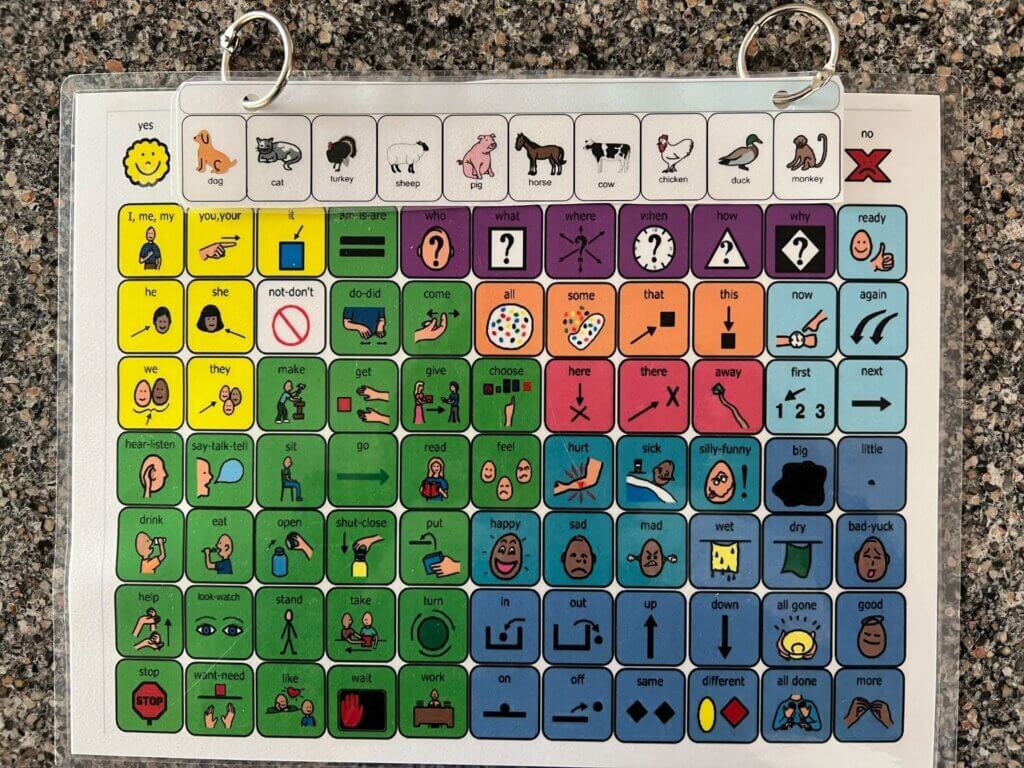
It does take students some time to learn where each icon lives on the board and what it means. But with consistent modeling and practice, motor memory takes over, and students start locating their words quickly and confidently. I started using Core Vocabulary with my own students in 2015 after learning about it at an AAC conference. I wasn’t sure I’d like it as much as PECS — but within a few months, I was completely hooked.
PECS vs. Core Vocabulary: Strengths and Limitations
PECS tends to shine when:
- You need a highly structured program with clearly defined steps and mastery criteria
- Your student needs explicit teaching to initiate communication and seek out a partner
- You want to build a pre-reading skill, since students learn to scan a sentence strip left to right
But PECS also has some real drawbacks:
- It requires at least two trained staff members, especially in the early phases
- Full training requires attending a two-day workshop
- Materials take significant time to prepare and require ongoing physical props and reinforcers
- It’s difficult for parents to implement consistently at home
- Pragmatic skills like commenting, asking, and answering questions are harder to teach
- Transitioning to a more sophisticated AAC device later means learning an entirely new method
Core Vocabulary tends to shine when:
- You want a system that requires minimal extra staff or specialized training
- Materials are simple to prepare, and boards are highly portable
- You need to teach a wide range of pragmatic skills — requesting, commenting, protesting, and answering questions
- Aided Language Stimulation and communicative turn-taking are priorities
- Your student has physical limitations and can point or use eye gaze instead of manipulating cards
- You want a natural stepping stone to a higher-tech AAC device later on, since pointing to pictures transfers easily
- Parents want to use the system at home with minimal training
Core Vocabulary’s limitations are worth knowing too:
- There’s no set curriculum or lesson plan to follow — you’re building the approach yourself
- Core words aren’t standardized, so boards can vary widely from classroom to classroom
- Boards have a limited number of words, and as that number grows, icons can become harder to tell apart and locate
- It can feel intimidating to adults at first, especially with a busy-looking board
- Success depends heavily on adults consistently modeling and using the board themselves
When Should You Use Each Approach?
Consider PECS when your student needs to learn to initiate communication and build joint attention skills from the ground up. It works well if your student doesn’t mind physical touch or guidance, understands cause and effect, and can physically manipulate picture cards. Keep in mind that PECS also requires strong teacher buy-in and dedicated time and resources to implement well — without that, it’s very difficult to run successfully.
Consider Core Vocabulary when your student already initiates communication fairly easily, engages in joint attention, and understands cause and effect. It also helps if your student imitates gestures or words, since that skill transfers naturally to pointing at icons as a communication partner models the board. Core Vocabulary is a great alternative if your student doesn’t like being touched, since physical cues are optional rather than essential. It’s also ideal if your student struggles to manipulate individual picture cards, since pointing (or even eye gaze) works just as well.
Beyond the student’s individual profile, Core Vocabulary tends to be the more practical choice for busy classrooms and homes. Boards are inexpensive, portable, and easy to laminate and reproduce, so multiple copies can live in different areas of a room. And because the training barrier is so much lower, parents can typically pick it up and start using it at home with just a little guidance.
Final Thoughts
Both PECS and Core Vocabulary are excellent, evidence-based low-tech AAC options — I’ve had genuine success with both over the years. In many cases, they’re not even mutually exclusive: a student might start with PECS to build initiation skills, then transition into Core Vocabulary as those skills develop. The right choice really does depend on your individual student and your classroom’s resources.
If you’re just getting started with AAC, my advice is this: look closely at what your student can already do, weigh how much staff time and training you realistically have available, and don’t be afraid to adjust course if the first approach you try isn’t clicking. You won’t go too far wrong with either one.
Free Sample: AAC Core Vocabulary Story — I, Me, My & Mine
Want to try core vocabulary before you buy? Grab this free sample targeting the words I, me, my, and mine — perfect for nonverbal or minimally verbal students, or anyone who could benefit from AAC. It’s an animated, interactive PowerPoint story that builds motor memory and encourages repeated modeling in a fun, motivating way. Works great for push-in therapy, teletherapy, or home practice, and includes a free printable 21-icon core board to use right alongside it.

Try Core Vocabulary in Your Own Classroom
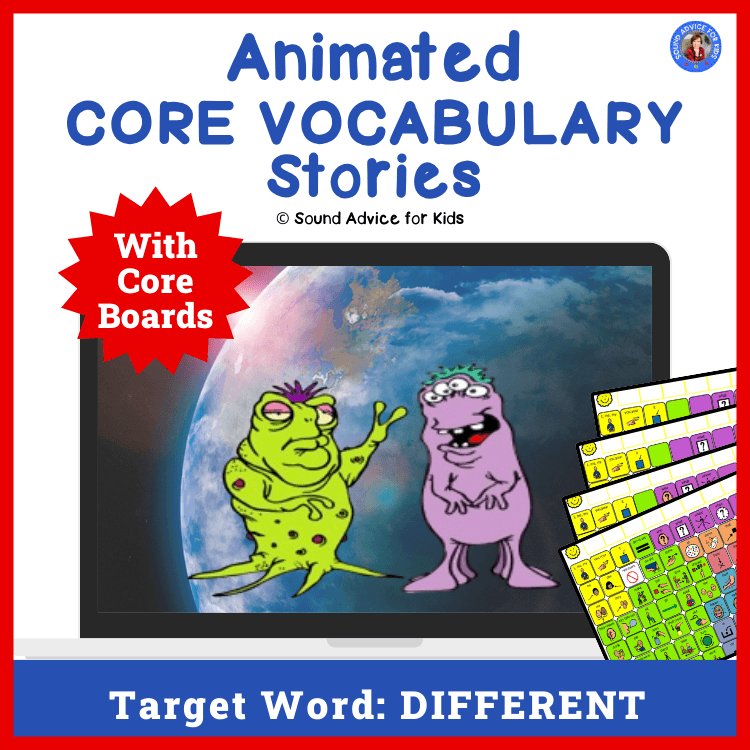
If you’re ready to put core vocabulary into practice, my AAC Core Vocabulary Activity: DIFFERENT is a great place to start. This interactive digital PowerPoint story targets the word “different” through an animated alien-planet adventure, building motor memory as students repeatedly locate the word on a core vocabulary board. It includes four ready-to-use masked core boards (21, 30, 50, and 77 icons) to reduce visual overload for beginners, and it works on any device with PowerPoint — perfect for push-in therapy, teletherapy, or sending home for extra practice
Frequently Asked Questions
What’s the difference between PECS and Core Vocabulary?
PECS uses picture exchange — a student hands a picture to a communication partner to request an item. Core Vocabulary uses a communication board of mostly verbs, pronouns, and descriptors that a student points to. PECS builds initiation skills through a structured six-phase program; Core Vocabulary builds flexible, everyday communication across many pragmatic functions.
Which is easier for parents to use at home, PECS or Core Vocabulary?
Core Vocabulary is generally easier for parents to pick up, since it doesn’t require the two-day workshop or trained staff that PECS does. A core board can be modeled with minimal training, making it more practical for consistent home use.
Why does Core Vocabulary focus on verbs and pronouns instead of nouns?
Core words like verbs, pronouns, and prepositions are used across almost every situation, while nouns are situation-specific. Adults use about 200 words for roughly 80% of daily communication, and most of those are core words — so they give a student far more communicative mileage than nouns like “scissors” that only apply in narrow contexts.
Does PECS require special training?
Yes. Full PECS training typically requires attending a two-day workshop, and early phases call for at least two trained staff members to run correctly.
Can a student use both PECS and Core Vocabulary?
Yes. The two systems aren’t mutually exclusive. A common approach is starting with PECS to build initiation and joint attention, then transitioning to Core Vocabulary as those skills develop.
Is Core Vocabulary a good stepping stone to a higher-tech AAC device?
Yes. Because Core Vocabulary relies on pointing to pictures on a board, that skill transfers naturally to a speech-generating device or app, making it a common bridge to higher-tech AAC.
Which system works better for a student who doesn’t like being touched?
Core Vocabulary tends to work better in that case, since physical prompting isn’t required — pointing or even eye gaze is enough. PECS relies more heavily on physical guidance, especially in early phases.
About the Author
Merrie McLean Smithson, M.S., CCC-SLP, is a speech-language pathologist with 30 years of experience, much of it spent providing push-in therapy in preschool and special education classrooms. She shares practical, classroom-tested strategies for AAC, vocabulary development, and collaborative speech therapy on her blog, Sound Advice for Kids. Grab her free resources for Push-in and Pull-out Speech Therapy.
Merrie’s products can be found on Teachers Pay Teachers and Boom Learning. She can also be found on Instagram, Facebook, and YouTube.
Questions or Comments? Email Merrie at me****@****************ds.com. She’ll be happy to hear from you.