
Replacement behaviors sound simple until you are standing in front of a student who is throwing chairs, and you realize that “use your words” is exactly the thing he cannot do right now.
I have spent more than 30 years working in and around special education classrooms as a Board Certified Behavior Analyst and doing research on behavior. Choosing the replacement behavior is where I see the most behavior plans quietly fall apart. Not because teams are not trying. Usually because they picked the replacement by looking at the behavior instead of at what the behavior was getting.
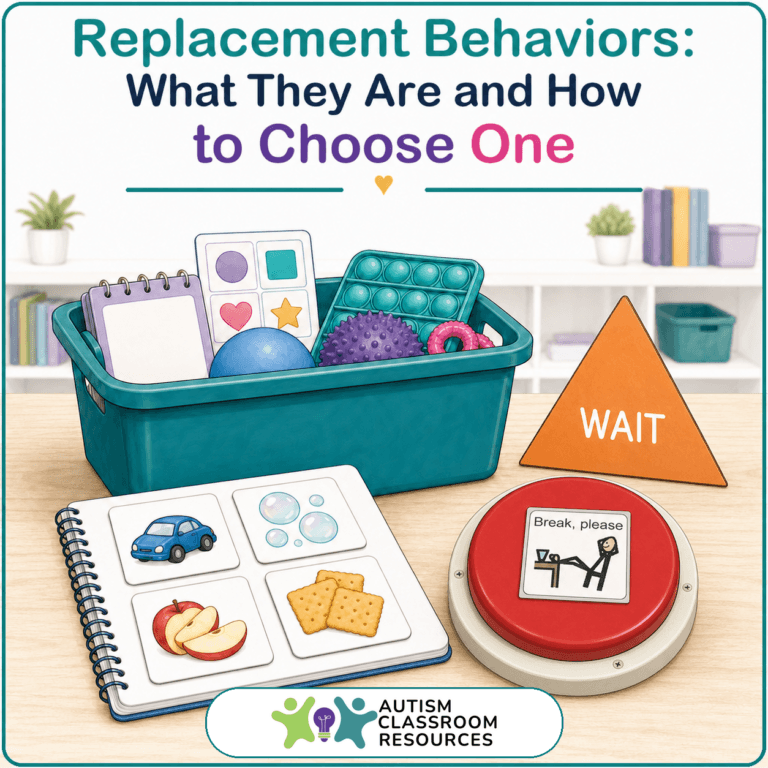
What is a replacement behavior? A replacement behavior is an appropriate skill that is maintained by the same consequences as the challenging behavior. Because it serves the same function, it gets the student the same need met in a way we can accept. If hitting got a student out of math, the replacement skill has to get him out of math too.
In this post I will walk you through what makes a replacement behavior work, why you cannot pick one from the behavior itself, and examples of replacement skills for each function of behavior. The teaching procedure most of these skills get taught through is functional communication training, and it is worth reading alongside this one.
What is a Replacement Behavior?
A replacement behavior is an appropriate skill that is maintained by the same consequences as the challenging behavior. The point is that by serving the same function, the appropriate skill can be used to get the same need met in a more appropriate way.
An example would be teaching a student whose behavior is determined by the functional behavior assessment to serve to gain reaction or attention from his peers to tell jokes to get that same reaction.
You will also see this called a functionally equivalent replacement behavior. That is the same thing. “Functionally equivalent” means the new skill and the old behavior get the student the same outcome. Your functional behavior assessment (FBA) is what tells you what that outcome is, which is why the detail in your hypothesis statements matters so much. A vague hypothesis produces a vague replacement behavior.
Why There is No Replacement Behavior for Hitting
This is the question I get asked more than any other, in one form or another. What is the replacement behavior for hitting? For spitting? For screaming?
I understand why it gets asked that way. You are looking at a behavior, and you want to know what to do about it. But we can’t answer the question without knowing WHY the behavior is happening.
Imagine if you had 3 students, in 3 different classrooms, who all spit at adults.
The FBA on Student 1 shows the spitting happens during independent work, and it stops the moment the work is pulled away. That is probably an escape-related behavior. Her replacement behavior might be a way to ask for a break from work.
Student 2 spits when adults are talking to each other and not to him. More times than not, an adult turns around to redirect. That spitting is likely reinforced by attention. His replacement behavior could be a way to get an adult to attend to him, like calling their name and having them respond, at first all the time. Then they can start to teach him to wait for attention when he asks.
The third student spits at his desk when he is alone and play with it with his fingers (yes, it’s gross!). That might be an automatic reinforcement. We may want to look for something that he can request to play with something slimy that is more hygenic.
Same behavior. Three completely different plans.
If you had started from a list that said “spitting equals asking for attention” you would have been right for one student out of three, and you would have spent months teaching the other two something that could not possibly work.
We have a lot of strong evidence to support this, starting wtih Carr and Durand in 1985. They found that teaching a communication skill that is not related to the function of the challenging behavior does not reduce the behavior. It cannot. The behavior is still the only thing that gets the student what he needs, so the behavior stays.
A student who hits to escape work and is taught to ask for attention will keep hitting. His behavior didn’t function to get attention, so asking for attention while continuing with work wasn’t effective.
So when you find a list online that maps behaviors to replacement skills, what you are actually looking at is somebody’s guess about which function is most common for that behavior. Sometimes that guess is reasonable. But we do an FBA so we don’t have to guess.
What to do instead
Start with the function, not the behavior. Complete an FBA, identify what the behavior is getting for the student, and choose the replacement skill from that. The next section is organized that way on purpose.
If your FBA does not give you a clear function, that is the problem to solve first. No amount of care in choosing a replacement behavior will rescue a plan built on a guess about function. However, if you some ideas of the function, you could try one of the replacement behaviors and take data on whether the behavior decreases. If it does, you might have the function. So don’t feel like you have to stay in the FBA phase forever.
| Function | What the student is getting | Replacement skills that get the same thing |
|---|---|---|
| Escape or avoidance | Getting out of, or away from, a task, a demand, a person or a setting | Asking for a break; asking for help; “all done”; “no thank you” and other appropriate protest; asking for a different activity; asking to leave a situation; asking for a shorter task. Once they reliably use the strategy, we can start embedding demands. |
| Attention | A reaction from an adult or from a peer | Asking for attention (“look at me,” “talk to me”); tapping a shoulder; raising a hand; bringing finished work to an adult; telling a joke or a story. Once they can do it reliably, we can teach them to wait. |
| Tangible access | A particular item, food, or activity | Requesting the item by word, sign, picture or device; “my turn”; asking “can I have ___”; choosing from a choice board; waiting for the item with a visual |
| Automatic or sensory | Internal reinforcement, meaning how the behavior itself feels | An alternative that produces the same input, whether that is oral, movement, deep pressure, visual or auditory; relaxation strategies when the behavior relieves anxiety; scheduled access to the input before it is needed |
Escape is where many of us balk. Teaching a student to ask to get out of work is counterintuitive to what we do for a living. However, you have to think about it as a step in the process. First, we teach the student to ask to get out of work…and then we teach them to work little by little. And let’s face it, if the student is throwing all the work you give him, he isn’t getting work done anyway. You can learn more about teaching a break and then reintroducing work in this post.
Automatic reinforcement is where a communication skill might not help at all, because there is nobody the student needs to communicate with. Unless you have something that creates the automatic reinforcement, and they. can ask for that. You are looking for something that delivers the same input, which is a different kind of search. Learn more about automatic reinforcement replacements here.
Attention-seeking behavior has enough going on that it gets its own post. If that is what you are dealing with, read teaching appropriate attention-seeking behavior.
There is a Small Exception
I said the form of the behavior does not tell you the replacement. There is one place where the form tells you something.
When the FBA says automatic reinforcement, the reinforcer is a sensory consequence, and the form of the behavior is a clue about which sensory channel that consequence lives in. A student chewing his shirt is probably getting oral input. A student rocking is probably getting vestibular input. That narrows where you look.
And this only applies once the FBA has already told you the function is automatic. Plenty of shirt chewing is escape. Plenty of rocking is attention. The form gives you a hint about the channel only after the function is settled, never instead of settling it.
It Also has to be More Efficient Than the Challenging Behavior
Matching the function is the first requirement. The second one is efficiency based on Horner & Day (1991).
The replacement behavior needs to be more efficient than the challenging behavior at getting the reinforcer. Three things make up efficiency: it has to be faster, easier and more reliable.
Faster
It has to get help, escape, attention or internal reinforcement more quickly than the challenging behavior does. If hitting the teacher gets a student out of work immediately, but asking for a break means waiting until the end of the activity, hitting is going to continue because it’s getting reinforced.
Easier
The replacement also has to take less effort. A 12-word sentence is not easier than throwing a book. Pick a form the student can produce while he is upset, not the form you would like him to use eventually. You can shape it later.
More reliable
Finally, it has to work every time, at least at first. If asking for a break works on Tuesday and gets denied on Wednesday, the student has learned that hitting is the dependable option and asking is the gamble.
You get efficiency two ways: through the form of the skill you choose and through how you differentiate your response. Reinforce every instance of the replacement behavior immediately, while delaying or reducing reinforcement for the challenging behavior. Later you can start building in demands or teaching waiting.
When You Cannot Find a Replacement Behavior
There will be times when we cannot figure out what a good replacement behavior would be. The most common one is when the behavior serves an automatic function and we cannot identify what the actual reinforcer is.
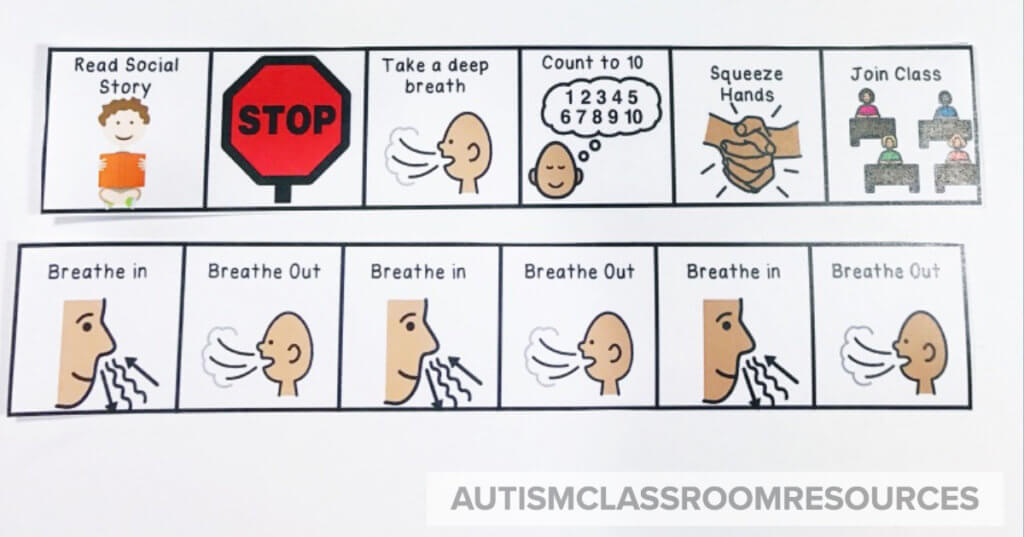
But if it appears to be reinforced by the sensation of pulling out her hair, then figuring out a replacement for that is much harder. In that case we might increase other behaviors that keep her hands busy and engaged. That does not replace the behavior. It substitutes for it, and it needs more ongoing support to work.
For instance, if you work with a student who pulls out her hair, and the FBA indicates that it functions to gain automatic reinforcement, our replacement behavior would need to elicit that same reinforcement. If it seems to be related to anxiety, we might be able to teach relaxation strategies to reduce the anxiety.
Teaching the Skill is not the Same as Naming it
It is important to recognize that telling a student to “use your words” is not the same as teaching a replacement skill. Some students already have the words and only need a cue.
But most of your students have not been successful when they say “I don’t want to do this” or “Talk to me.” Sometimes they do not have the words. Sometimes they do not ask in a way that people accept.
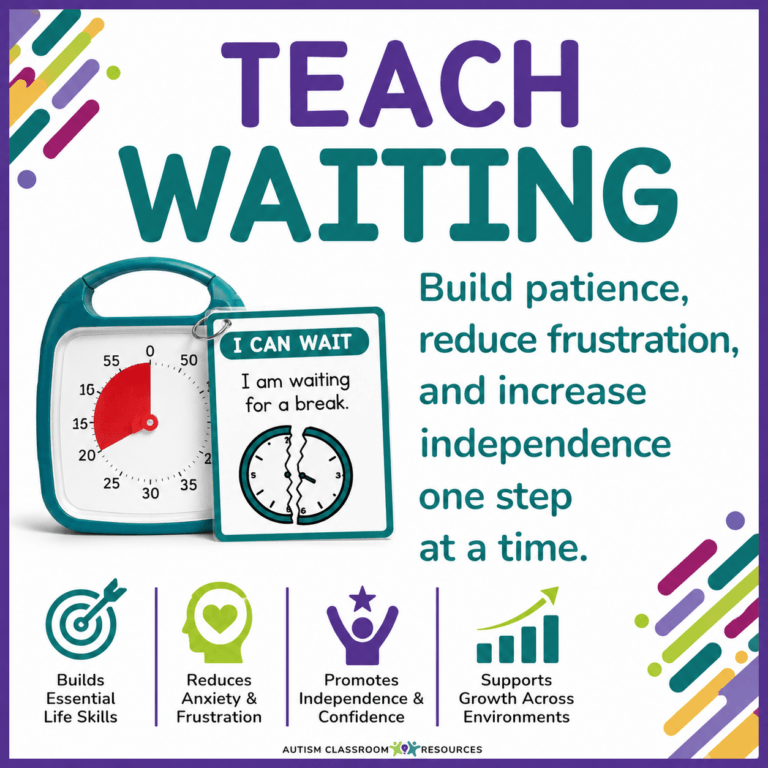
Here is a common example. For behaviors that function to get a situation to stop, I teach the student to ask for a break. When was the last time you heard a student voluntarily ask for a break?
Instead, when they are not using challenging behavior, they say “I don’t want to” or “No!” And as teachers we often do not give in to those. So their replacement words are not working, and the challenging behavior comes back, because it still works better.
That is why I teach students to communicate “I need a break.” It does not evoke the natural reaction of telling a student to get back to work, and it travels across settings. You can read more about how I teach that skill in how to teach students to request a break.
And we do not stop at the communication skill. We go on to teach the student to do a little work at a time before getting the break, or to wait before getting attention. That is what keeps the plan usable in a real classroom instead of only on paper.
Frequently Asked Questions About Replacement Behaviors
What is the replacement behavior for hitting?
There is not one. Hitting can serve escape, attention or access to something, and the replacement behavior depends entirely on which. The same is true of spitting, screaming, throwing and elopement. Read the FBA, identify the function, then choose the replacement skill that produces that same outcome.
What is a functionally equivalent replacement behavior?
A functionally equivalent replacement behavior is a skill that gets the student the same reinforcer the challenging behavior was getting. If the FBA says the behavior functions to escape a demand, the replacement has to produce escape. Same outcome, different form.
Replacement behaviors are taught so that what?
Replacement behaviors are taught so the student has an appropriate way to get the same need met. You can often reduce a behavior without teaching a replacement, but the need is still there, and another behavior tends to appear in its place.
Do replacement behavior strategies have to include reinforcement procedures?
Yes. A replacement behavior only holds if it is reinforced immediately and every time at first, while reinforcement for the challenging behavior is delayed or reduced. Without that difference in your response, the old behavior stays the more efficient option and the student keeps using it.
Is functional communication training a replacement behavior?
Functional communication training is the procedure for teaching one. FCT teaches a communication skill that serves the same function as the challenging behavior, so the skill it produces is the replacement behavior. Not every replacement behavior is a communication skill, though. Automatic and sensory functions usually need something else.
What is the difference between a replacement behavior and a coping skill?
A replacement behavior serves the same function as the challenging behavior. A coping skill helps a student tolerate a situation. Deep breathing is a coping skill, and it becomes a replacement behavior only when the FBA shows the behavior functioned to relieve anxiety.
Can a replacement behavior be a skill the student already has?
Sometimes. Some students already have the words and only need a cue to use them. But most students who use challenging behavior have already tried the appropriate version and found it did not work, so the skill needs teaching, not reminding.
How do I choose a replacement behavior for automatic reinforcement?
Look for something that produces the same sensory input. The form of the behavior is a clue to which sensory channel is involved, but only after the FBA has established that the function is automatic. You then have to test whether the alternative actually competes, because for some students it will not.
How many replacement behaviors should a behavior plan have?
Usually one. Pick the skill that matches the function and is easiest for the student to produce under stress, teach it until it is automatic, and then add. A plan listing six new skills is a plan nobody has time to teach.
Looking for Tools to Help with Teaching Replacement Skills? Check out these Toolkits
-
Social Stories – Waiting for Attention & Getting a Teacher’s Attention
$6.00 Add to cart -
Sale!
Self-Regulation Support Bundle: Social Stories & Visual Tools for Behavior and Emotions
Original price was: $18.00.$14.20Current price is: $14.20. Add to cart -
Calm Down Corner Tools: Social Stories & Visuals for Self-Regulation & Behavior
$5.50 Add to cart -
Social Stories on Following Directions and Daily Routines – Behavioral Toolkit for Students With Autism
$4.00 Add to cart -
Making Mistakes Social Stories and Toolkit for Behavioral Self-Regulation
$8.00 Add to cart -
Managing Anxiety with Coping Skills, Social Stories, & Visuals Supports for Self-Regulation
$4.50 Add to cart
References
Carr, E. G., & Durand, V. M. (1985). Reducing behavior problems through functional communication training. Journal of Applied Behavior Analysis, 18(2), 111–126. doi:10.1901/jaba.1985.18-111
Horner, R.H., & Day, H.M. (1991). The effects of response efficiency on functionally equivalent competing behaviors. Journal of Applied Behavior Analysis, 24(4):719-32. doi: 10.1901/jaba.1991.24-719.
This post was written completely by Christine Reeve, Ph.D., BCBA-D. AI was used for SEO and some editing and images.