
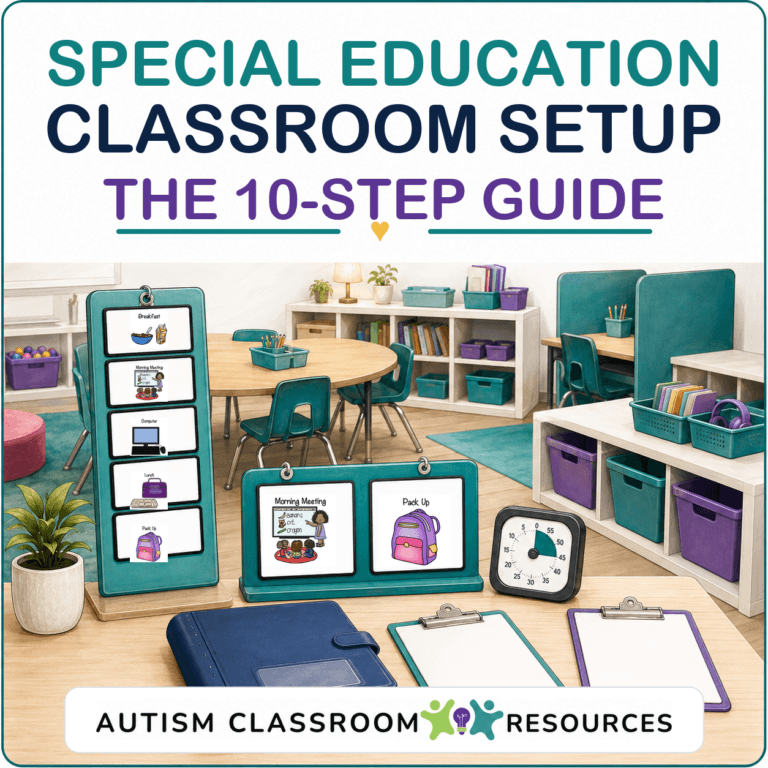

Special education classroom setup is tough. You don’t always know which students you are getting. Will last year’s setup work? It’s a new room, and you don’t know what furniture you have. And sometimes you end up setting it up and making changes for the first month of school.
Table of Contents
Autism Classroom Setup: The 10-Step Guide
Setting up a special education classroom works best in a specific order: know your students first, then build the schedule, then design the space around that schedule, then assign your staff to it. Visuals, materials, curriculum, communication tools, data systems, and lesson planning get built from there, and they keep changing through the first month. Room design is the most visible part of setup, so it’s where most teachers start — and it’s usually the part that gets redone.
If those descriptions fit your situation, this post and those linked within it can help. And you might also want to check out the Special Educator Academy where we have a whole course just on setting up an autism classroom from the schedule to the staffing.
In this post I’m going to introduce each of the 10 steps with some additional things to think about thrown in. And I’ll link out to posts that walk you through HOW to implement the strategies.
I’ve spent more than 30 years in and around autism classrooms — as a teacher, a consultant, and a behavior analyst — and I co-wrote a book on this exact topic, Setting Up Classroom Spaces for Students with Autism. This is the order I’ve landed on.
1. Plan Around the Students from the Start
General education teachers certainly individualize and differentiate in their classrooms to meet the needs of individual students as they get to know them. In special education, everyone expects us to hit the ground running in meeting the individual needs of our students, because that’s our job. IEPs are expected to be followed throughout the year from the first day of school on….there’s no, “when we get settled in we’ll start running that behavior plan.”
So, before we even start to think about what setting up an autism classroom will look like or our day will look like, what strategies we want to try this year, or how we want to arrange the furniture, we have to think about the needs of the students we will have. So, that has to be step number 1.
Part of that is reading through every student’s IEP. I know it’s tempting to “get to know the student first,” but let’s be real. If I have a student entering the classroom with severe behavior, I need to know the behavior plan from Day 1.
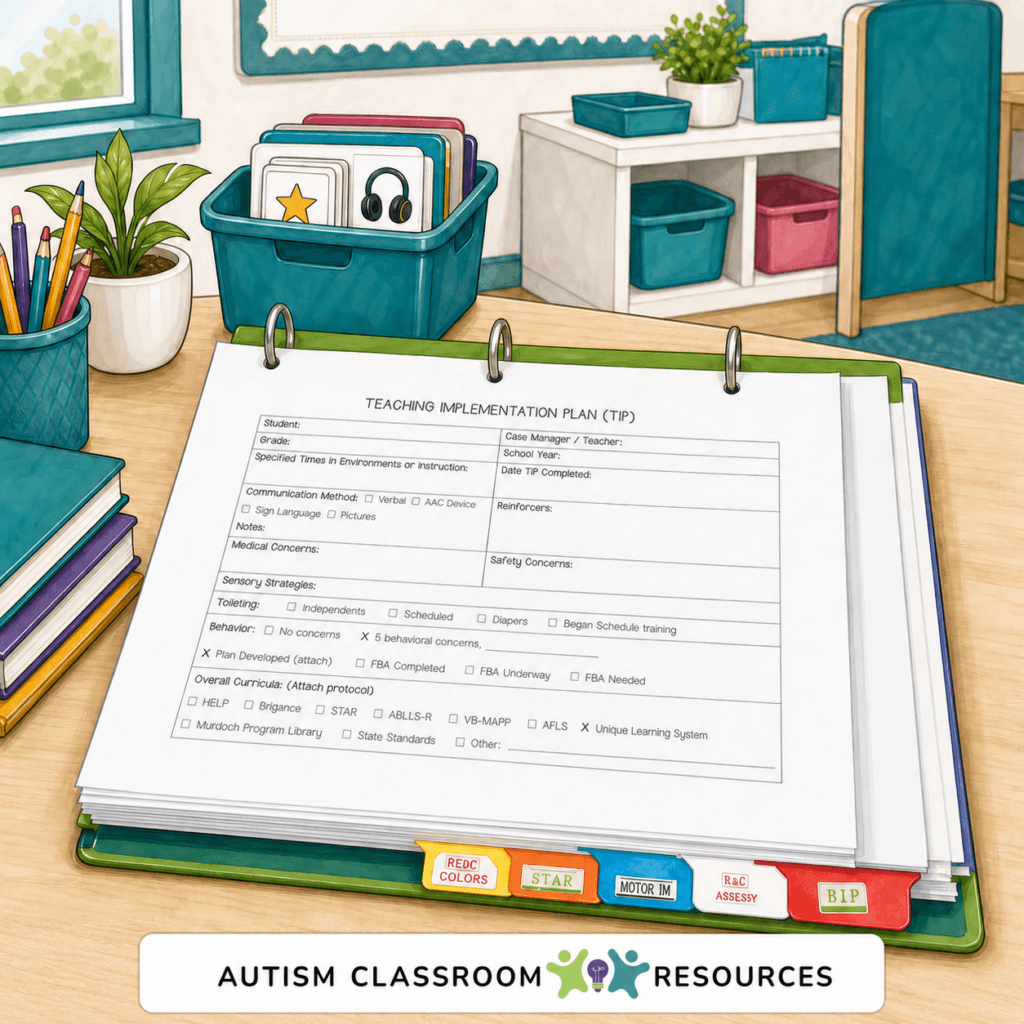
Your schedule is going to change based on the students you have in your classroom. To get to know the student, and use that information to plan out the classroom, I start by creating the Teaching Implementation Plan (TIP).
2. Setting Up the Classroom Schedule
Once you know who your students will be, your next task is to actually begin to put the schedule together. I know that sometimes you don’t know when specials will be…and we all know they will be changed 15 times in the first 2 weeks. But you have to start somewhere.
Once you’ve done the TIP, making your schedule gets a little bit easier…in a Jenga move activities around kind of way. I use a classroom grid with the students’ names at the top and time increments down the left side. For some classrooms those time periods are 10 minutes; sometimes they are 20 or occasionally more. If I’m not sure I default at 15 and make changes if I find that students this year need shorter activities.
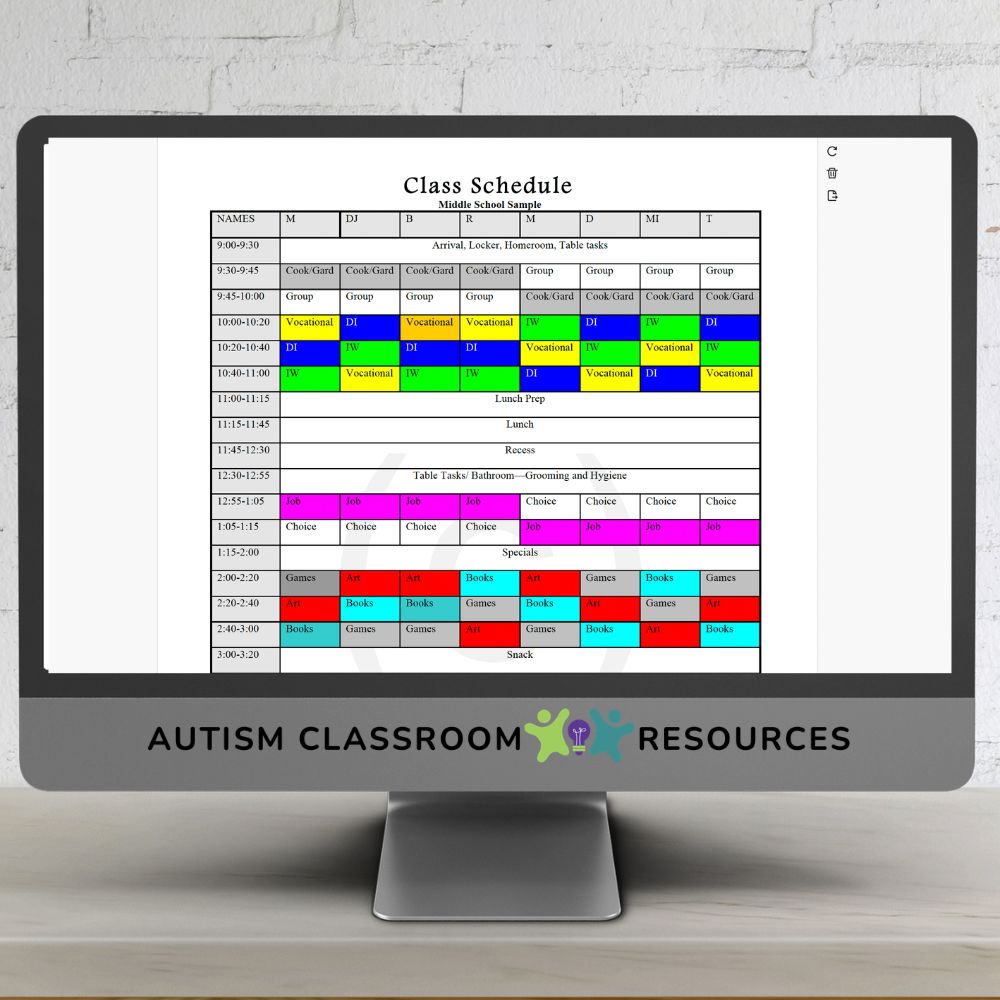
The key in setting up the classroom schedule is finding the sweet spot of student engagement levels. You want activities to be long enough to create meaningful engagement. But if your students are wandering away before the activity ends…it’s too long.
One key element to know about the schedule is that not every student has to engage in an activity for the same amount of time. If 2 students need a 10-minute morning meeting before they start to get antsy, but others can handle 20 minutes, then have the 2 students leave after 10 minutes and go do another activity like direct instruction or independent work. Chances are if you kept them, you would need to have staff with them, so let that staff go with them to the other activity while you continue on.
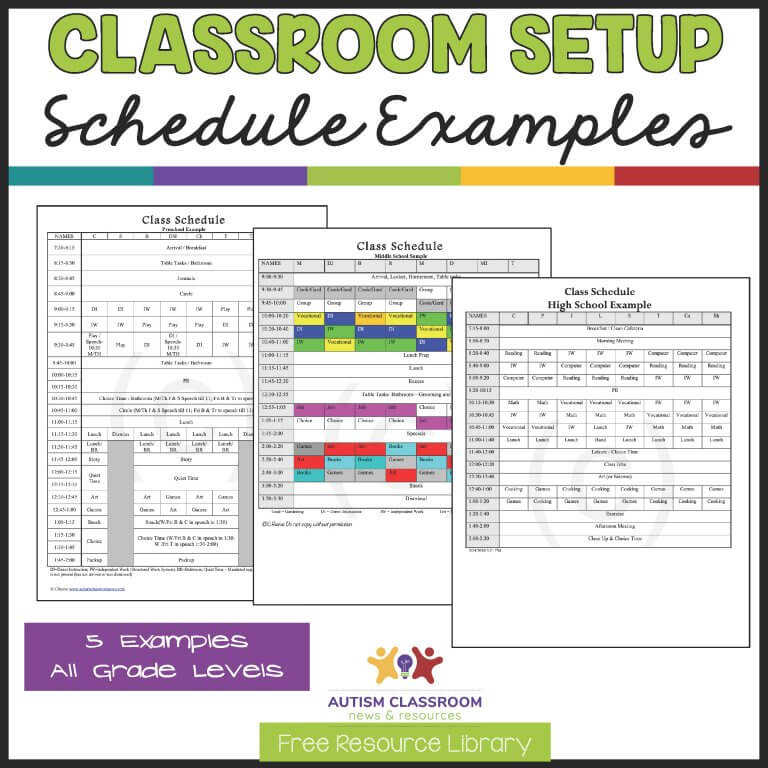
Check out this post to learn more about how I go about establishing a classroom schedule with centers. That post also has examples of real classroom schedules for different ages.
3. Classroom Design
Next up, how are you going to arrange the physical space of the classroom? Obviously steps 1, 2 and 3 happen somewhat simultaneously, but this is the order I find most useful. Because when I know what the activities are going to be, I can start to set up those spaces in the room.
There are a ton of decisions that go into determining the classroom setup, and you can read more about room design here.
Whether you have younger or older students, most students in a more self-contained classroom or resource classroom are going to benefit from clear boundaries in the room. However, I’ve found that most classroom furniture and materials were ordered by people who thought all classrooms were equal.
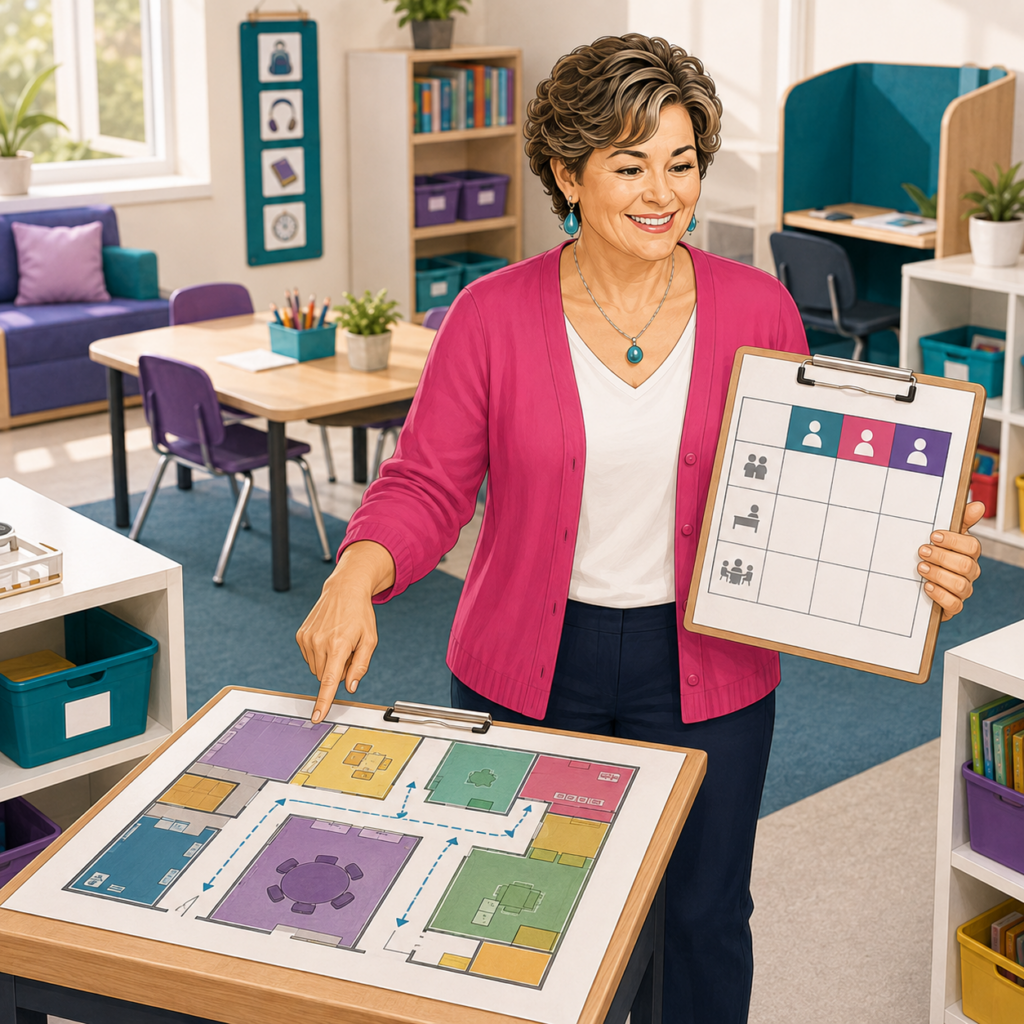
So you are likely to walk into a classroom scheduled to have 12 students and 3 adults and find 30 desks and chairs ready to be set up for a general education classroom. In addition, if you have built-in shelves around the room, you are likely to not have much furniture to divide the center of the room into spaces.
Putting the classroom design in place becomes easier when your schedule is set because you want the traffic to flow around the room and you want to have enough space in each activity for the number of students it will contain.
You can learn more about how I make decisions about classroom design in this post.
One Quick Note on Classroom Decor
Decor can sometimes be a touchy issue. I know that when it comes to setting up an autism classroom, decor (Ugh, I hate that phrase for some reason) is a big deal to many teachers.
And it’s important to have a classroom in which the teacher is comfortable as well as the students. Everyone should like to be in the classroom, so it should be bright, engaging and interesting.
However, I find all the time, money and effort spent on “decor” in setting up an autism classroom sometimes gets in the way of the meat of the teaching. I also find that the decor items (e.g., pom poms hanging from the ceiling) are sometimes distracting to SOME students. Now, this isn’t true for every classroom or every student.
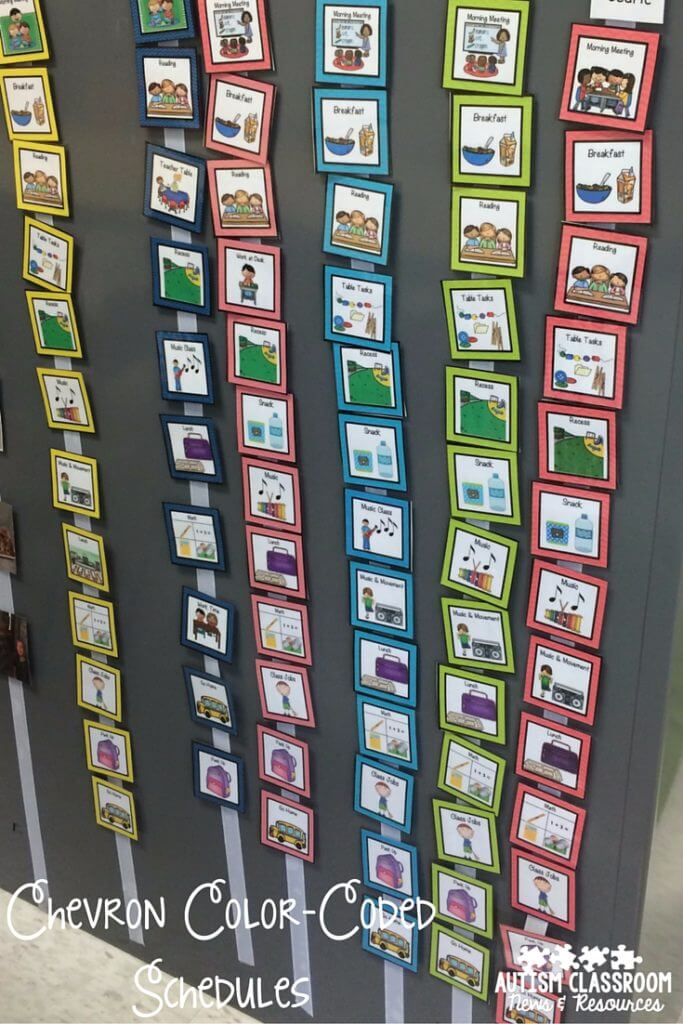
But, I find that once I put up the visuals needed by the students, the reminders needed for the staff, stash some PECS books and data sheet clipboards on the walls, then post lesson plans, schedules, and zoning plans, I don’t have a lot of room left for decoration.
4. Classroom Zoning and Building Teams
Scheduling the students is only half the job. Think of your job of classroom design as choreographing the classroom. You are creating a harmonious dance between students and staff around the schedule in the room.
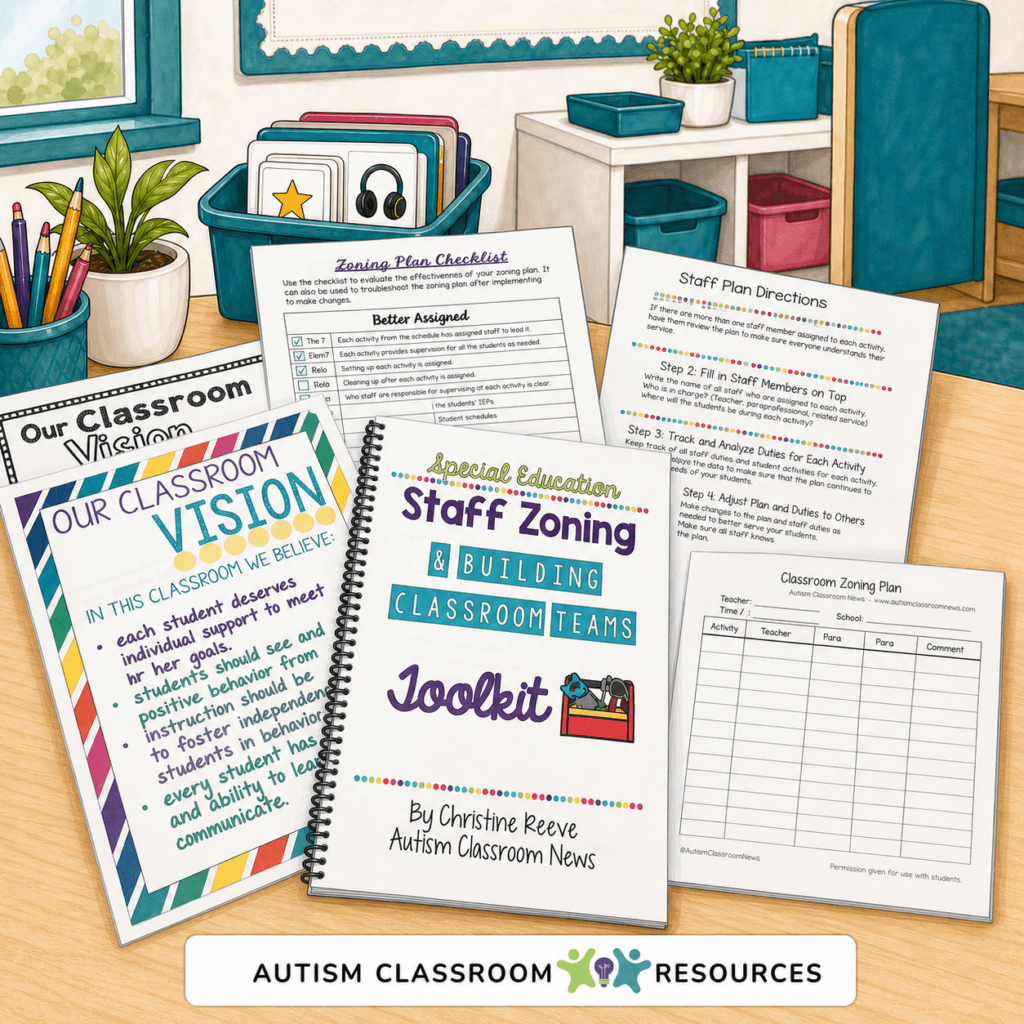
That means you have to have a staff schedule that matches up with the students’ schedule. And that’s why we create staff zoning plans. Staff zoning plans are schedules for the staff, but they are like a schedule on steroids.
They don’t simply tell the staff member who they are working with in what activity. They also give them information about the types of accommodations a student might be able to have; what they should remember to do before leaving the center (e.g., make sure to wipe down the table at the end of the activity).
-
Sale!
Special Education Classroom Setup Kit – Schedule, Plans, Visual Supports, etc.
Original price was: $119.15.$89.11Current price is: $89.11. Add to cart -
Sale!
Special Education Classroom Setup Kit Middle & High School – Schedule, Plans etc
Original price was: $119.80.$88.00Current price is: $88.00. Select options
Zoning plans also work well to address problems with staff working well together. When people know what the expectations are, they are more likely to follow through. And it gets rid of many of the difficult situations that might happen when you thought a staff member should know what to do, and they don’t.
Staff Zoning plans exist because staff can’t read your mind. Working in a self-contained classroom with other adults can be hard, but building teams is crucial. So you can read more about team building and leadership in the classroom here.
5. What Visuals Do I Need to Get Started?
Next up, we are ready to put the visuals for the students in place. It’s always amazed me as a consultant that often teachers are told they need visual schedules, but no one talks about:
- what the schedule of the room is;
- what kind of visual schedules make sense for a student.
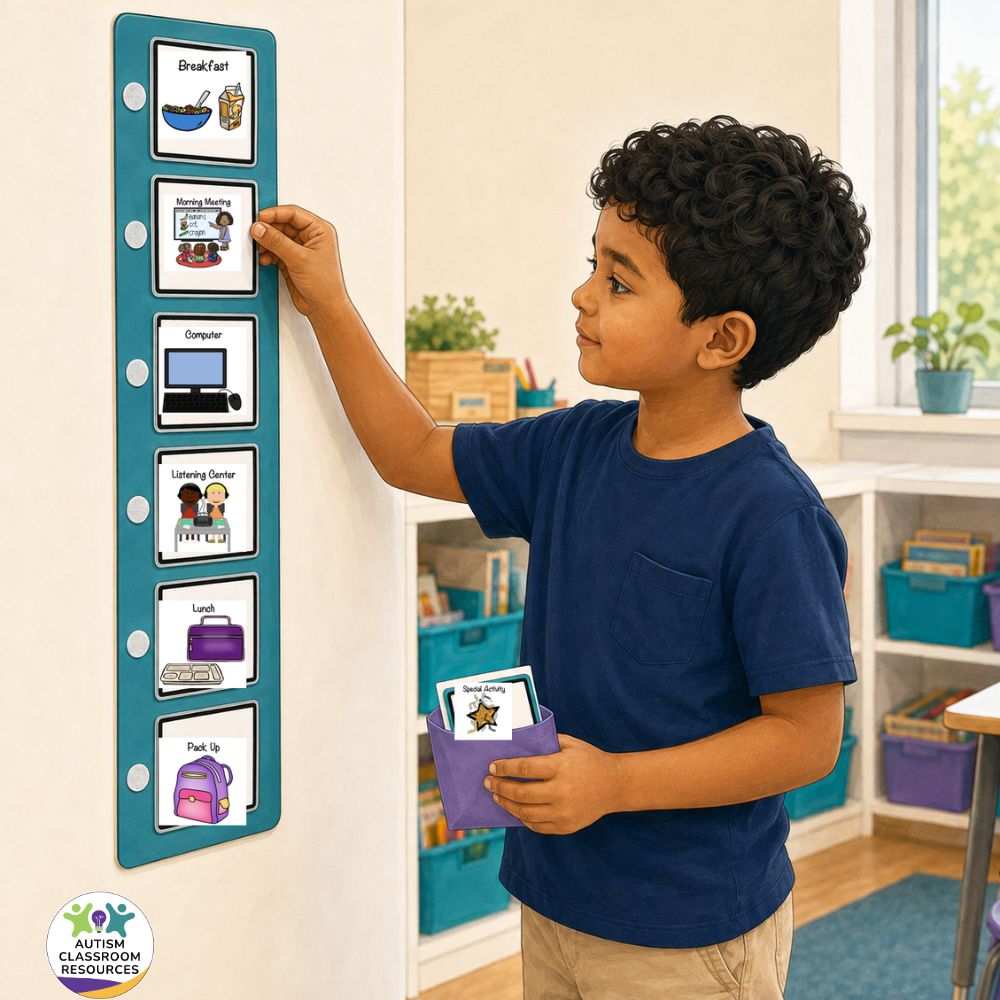
Schedules run the gamut: object schedules, picture icon schedules, photo schedules, or written schedules. In addition, you can have a full-day schedule on the wall for some students and part-day written schedules in a notebook for others.
So I gathered everything you need to know about using visual schedules into this post, with pictures, to help.
6. Organizing Classroom Materials
This step is often underrated, but how you organize your materials in the classroom is as important as the furniture. For instance, if staff don’t know where something is kept, they can’t help a student access it when needed. And putting some materials out where wandering hands can swipe them off a shelf may not be your best choice if you have a student who clears the room.
You want materials to be easy to access but sometimes you need them closed off. Some things you always want the student to be able to access (e.g., their communication devices). Some items are better kept in cabinets (e.g., snack foods).
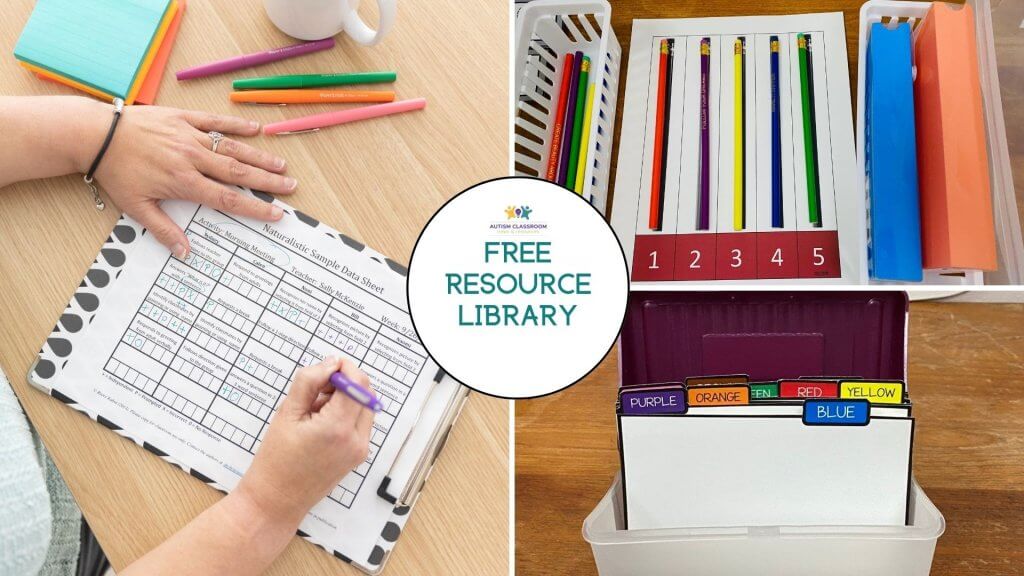
Having the materials you need where you need them when you need them is as important as where you put your morning group area. There are tons of things to think about when organizing materials, so I pulled my 5 best tips on organizing classroom materials into this post.
7. Choosing Curricula
For those of you who are newer teachers or new to different grade levels, don’t let anyone tell you that just because you teach special education you don’t need a curriculum. In fact, you need more than one curriculum.
General education teachers are given a textbook and curriculum they are expected to start with. Often special education gets left out of the discussion of the types of curriculum that is needed.
So, be proactive. Look at what curriculum is available in your classroom. As you learn about the students, think about what curriculum you are going to need. Read more about what I mean by curriculum and options for many of our students. Check out this post for what it is. Look at this one for a review of the Unique, this one for the STAR and this one for a discussion of functional curricula. And of course there are always reading and math curricula you will need as well as individual curriculum needs.
As you learn about your students, try to find out what curricula they have been using and where they left off so you don’t skip ahead or re-cover too much ground.
8. Choosing Communication Tools
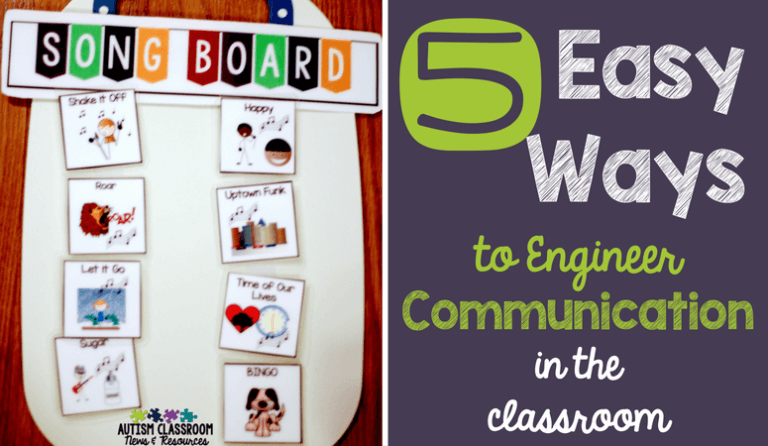
The next thing I do is think about adding communication boards around the classroom. My goal is to engineer the classroom environment for communication. have some common ones that I use throughout the year. And I have others that I add in as the year goes on or for special activities.
I want to make sure that all the communication systems are available to students throughout the day. Because if a student can’t access their system, they can’t communicate. Lack of communication is likely to lead to challenging behavior. Because I would be pretty testy if no one was listening to me too!
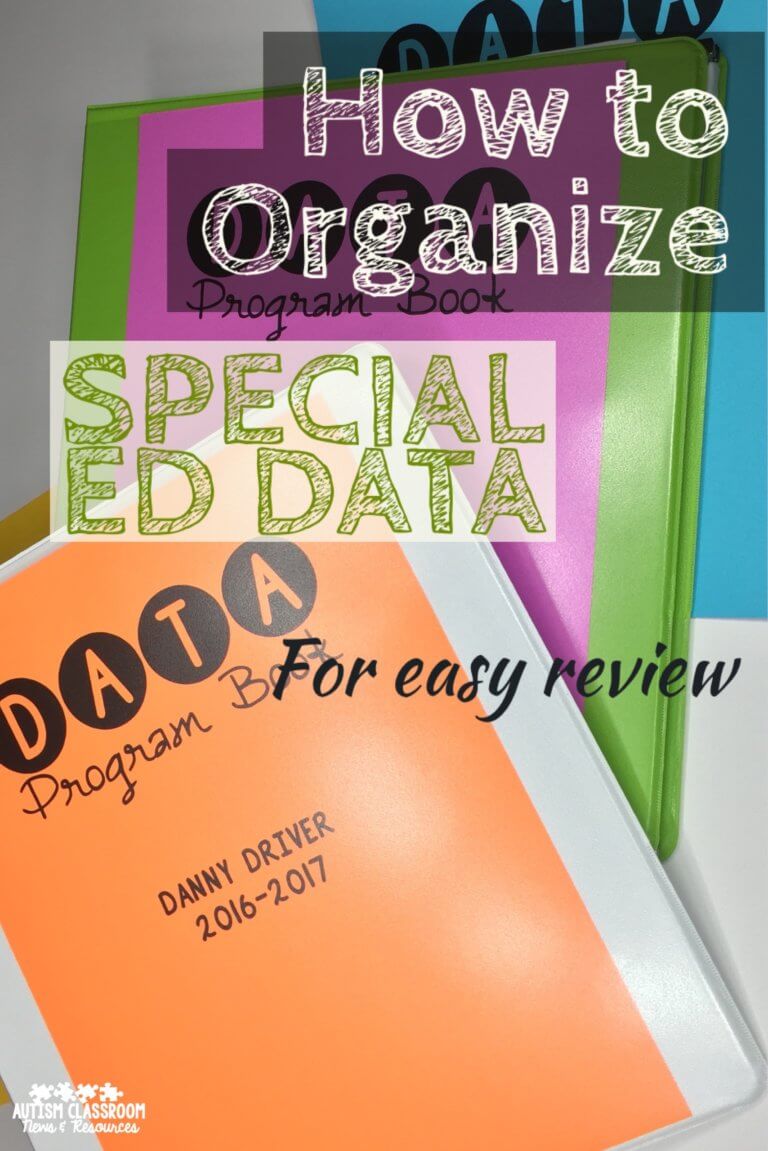
9. Organizing Data Collection Systems
Data collection systems are up next. And it’s important to have a system of data collection that you have thought out throughout the room. This is another reason why the TIP is so important.
If you’ve completed the TIP for each student, one of the elements you thought about was how you were going to collect the data for each of the IEP goals. I walk you through that process in this podcast episode (read the transcript if you’d rather).
10. Lesson Planning in the Classroom
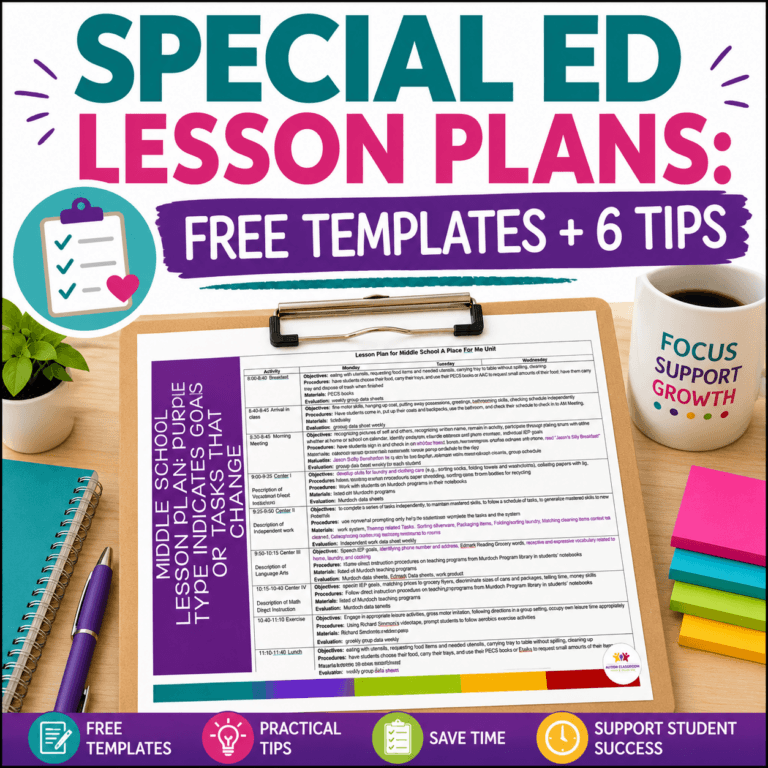
Many teachers think that you don’t need lesson plans in special education, particularly if you have the TIP, the schedule, and the zoning plan. However, none of those items tell the staff WHAT they should be teaching, what curriculum or lesson they should pull, or what materials they will need that day for that lesson.
For more information and free lesson plan formats, check out this post on creating meaningful lesson plans.
Special Education Classroom Setup: Common Questions
Where do I start when I don’t know my students yet?
Start with what you do have. Read the IEPs before you meet the students — goals, behavior plans, communication systems. Next design the classroom schedule, then the classroom floor plan and don’t forget to create a staff zoning plan.
You have to know everything you can about your students so the classroom is ready when they walk through the door. I’ve never had a classroom that I’ve not had to make changes to after the first day or the first week. But I also never want to run a classroom that doesn’t have the structure on day one.
What has to be done before students arrive?
Steps 1 through 4: teaching plans, the classroom schedule, the physical space, and the staff zoning plan. Those four are what make the room run. Visuals, materials, curriculum, communication tools, data systems, and lesson planning come next, and you’ll keep adjusting them through the first month. That’s normal, not a sign you set it up wrong.
How long does it take to set up a special education classroom?
Longer than the days most districts give you, and it isn’t finished when students walk in. Plan for the room to change through the first month.
Do I need a classroom theme?
Once you’ve put up the visuals students need, the reminders staff need, the schedules, lesson plans, and zoning plans, there isn’t much wall left. Decor is fine if you have room for it, though some students find things like pom poms hanging from the ceiling distracting. It isn’t a setup step.
What’s the most common mistake in special education classroom setup?
Setting up the room first and the systems second. A room arranged before you know what has to happen in it usually gets rearranged anyway.
Looking for More Help in Setting Up an Autism Classroom?